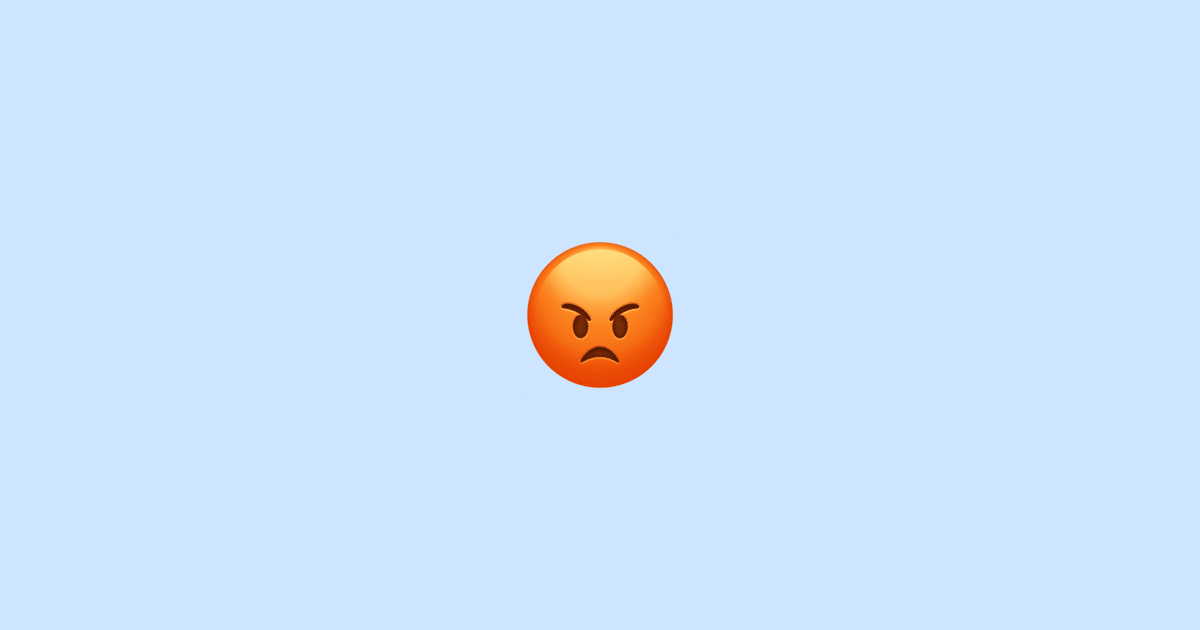
The emoji 😡, called pouty face Where face red with anger, expresses a intense anger and extreme exasperation. Its exact meaning depends on the context: hatred, tension, a simple sulk, or feigned anger expressed in the tone of humor and irony.
You can also find out more by clicking here are the 10 emojis that 9 out of 10 people misunderstand. And you, do you really know them?
To test your knowledge of emojis like 😡, you can take the quiz here :
😡 Meaning and a few examples of how to use this pouting emoji
L'pouty face emoji expresses a intense anger : resentment, exasperation, or a loss of patience. On most platforms, it takes the form of a red face with two little ones oval eyes, of the furrowed brows and an pouty mouth slightly curved.
The emoji that looks most like him is the angry face 😠. The real difference lies in the complexion : the pouting face turns red, sometimes a orange-red gradient depending on the device and messaging service. This color conveys a state of extreme tension, a form of hate or of rage temporary.
Be careful, though: in real life, this emoji is mainly used to express an emotion in a way that humorous, hyperbolic, or ironic. You rarely use it in a real argument.
Be sure to distinguish it clearly from similar angry emojis
There are several emojis related to anger, and it's easy to confuse them. Here's how to choose the right one based on the degree of intensity that you want to express.
| Emoji | Shade |
|---|---|
| 😡 Pouty face | Red Face : outright anger, exasperation, an expression that conveys more than just annoyance—it conveys hurt |
| 😠 Angry face | Moderate dissatisfaction, a look of annoyance |
| 😤 Smoke coming out of the nostrils | Frustration, determination, we're seething with rage |
| 🤬 Censored Speech | the maximum degree anger, veiled insults |
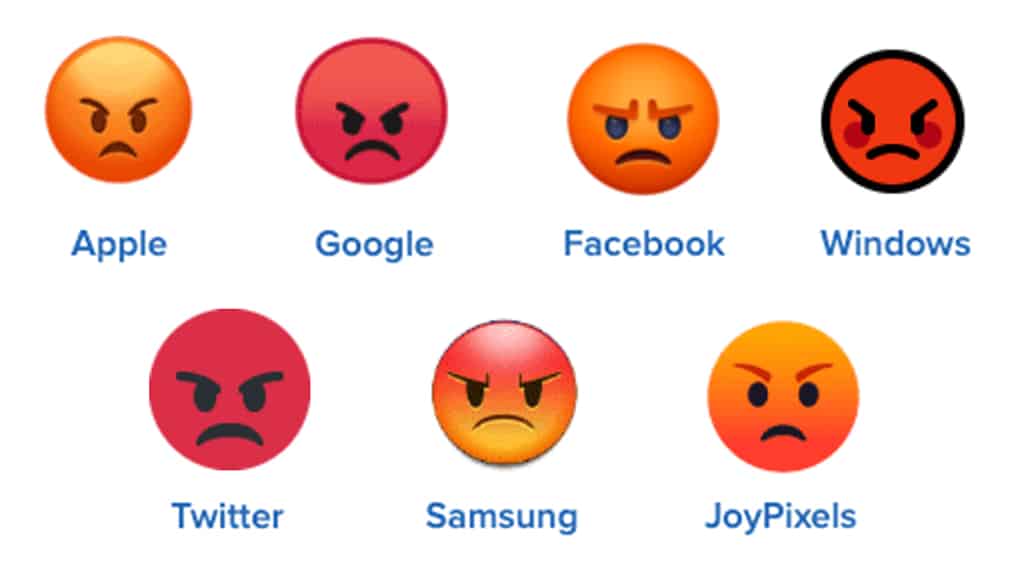
The display varies from one platform to another. At Apple, Google, Microsoft and Twitter, each version has roughly the same angry expression, with slight variations in the eyebrows and mouth.
Examples of Use in Conversation
Here are a few real-life situations where a pouty face comes in handy:
- Open Anger: «Stop saying that 😡.»
- Criticism: «I told you not to repeat that to him 😡.»
- A bit of irony among friends: «You finished the whole bag of chips again without me 😡.»
- Social media: «Another ad that cuts off my video 😡.»
😡 Origin of the sulky smiley
The pouting face originated in the emoji games of the Japanese mobile carriers. It was first included in the Consortium's proposal documents Unicode in 2007 (document L2/07-257), then in 2009 (document L2/09-026).
This work was carried out by several contributors from Google and Apple, whose Mark Davis, Markus Scherer and Kat Momoi.
The pouting face emoji was approved as part of’Unicode 6.0 in 2010, and then made official in version Emoji 1.0 published in August 2015. Since then, this red face has been available on virtually all platforms.
The characteristics of this sulky emoji
The pouting face remains one of the most commonly used emojis in social media conversations. Here are all the technical details:
| Version | Emoji 1.0 (2015) |
| Usual name | sulky face |
| Category | Smileys and Emotions |
| Sub-category | face-negative |
| Apple designation | Red face of anger |
| Unicode code point | U+1F621 |
| Decimal | ALT+128545 |
| Unicode Version | 6.0 (2010) |
| Key words | face, annoyed, angry, furious, sulky face |
| Other names | emoji with mustard running up its nose, angry emoji, emoji turning bright red with anger, aggressive emoji |
Show the person you're talking to that you're angry by inserting the emoji 😡 in your message.
To find out the meanings of other emojis, such as the angry face emoji 😠, the face with a monocle emoji 🧐 or the red smiley face 😊, just click on the links!








 English