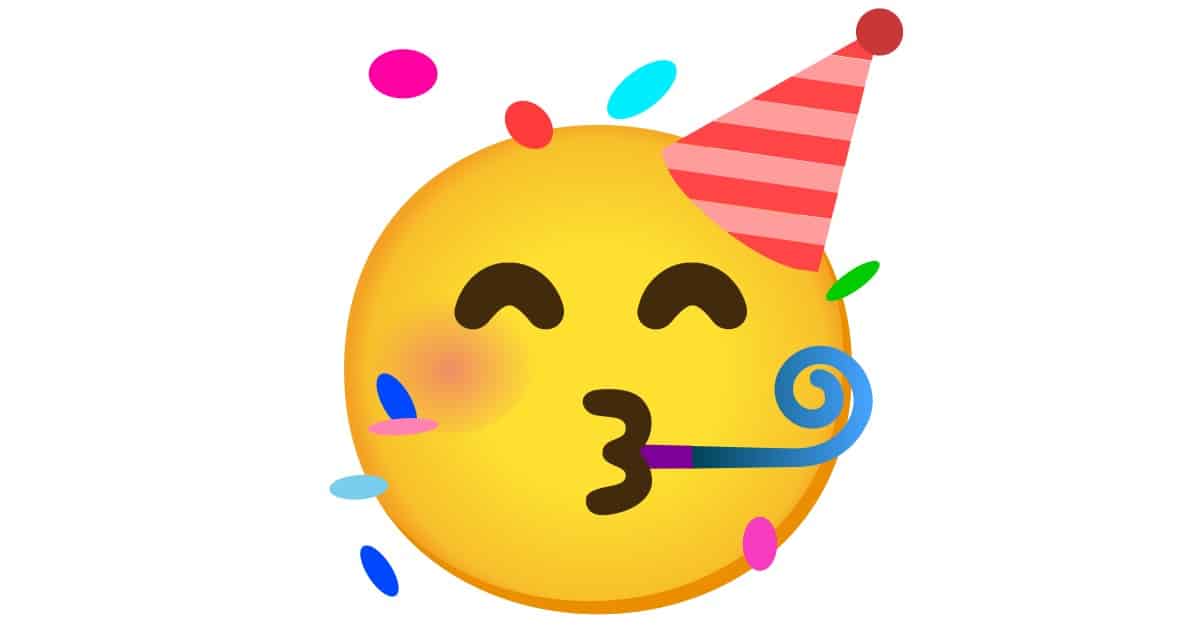
The 🥳 emoji expresses party, the celebration and joy. This festive expression, topped with a pointed hat and surrounded by confetti, is used to celebrate a happy occasion or to share your enthusiasm. Depending on the context, it may be used to wish someone a birthday, celebrate some good news, or launch a a sudden urge to party.
You can also find out more by clicking here are the 10 emojis that 9 out of 10 people misunderstand. And you, do you really know them?
To test your knowledge of emojis like 🥳, you can take the quiz here :
It represents the act of partying and celebrating an event
L'festive face emoji refers primarily to the act of to party. You use it to capture the festive spirit when an event is worth celebrating, whether it's a special occasion or just a spontaneous whim.
Visually, this smiling face wears a pointed hat festive and blows a whistle, all surrounded by confetti. The rendering varies slightly depending on the platform:
- On Google (Android), the face sticks out its tongue.
- On Apple (iOS) he flashes a big smile with the eyes crinkled with joy.
- On WhatsApp and Twitter, the design is slightly different, but the party hat is still there.
Its official name in English is Partying Face, its code Unicode is U+1F973 and its code HTML is 🥳. Its text shortcut is :partying_face:. It belongs to the category Faces and Emotions, along with other festive emojis like 🎉 or 🎊.
If someone sends this to you, it means they're letting you know that it's time to celebrate. It's the perfect way to kick off a party or celebrate a birthday or highlight a great achievement. For example: «During these vacation…’summer, », we should take this opportunity to celebrate! 🥳".
It expresses the wish of the wishes
On social media, the 🥳 emoji accompanies almost every greeting messages. Would you like a Happy Birthday to a loved one? That face, with its party hat It fits the mood perfectly, and the confetti further emphasizes the joyful nature of the message.
The idea is simple: you want to let someone know that you're thinking of them a lot on this special occasion. The festive expression conveys this feeling better than text alone. Here are a few specific situations where you can use the 🥳 emoji:
- «Happy birthday! 🥳» for a birthday.
- «Happy New Year! 🥳» during the season's greetings from the New Year's.
- «I wish you all the best! 🥳» for all your congratulations.
- «Congratulations on your degree! 🥳» to congratulate a success.
This emoji works just as well in informal settings as it does in slightly more formal ones: you can send it to a friend or a coworker for a going-away party. In any case, it’s still a sign of shared joy.
It also expresses joy for others
the festive expression is also a way to celebrate good news involving a loved one. Passing an exam, the arrival of a newborn, a promotion: all perfect opportunities to send this emoji and show that you're sharing in the other person's joy.
Here are a few examples of sentences where the 🥳 really comes into its own:
- «I heard you're expecting a baby—congratulations!»
- «Congratulations on your promotion—you really deserve it!»
- «That's such great news—I'm so happy for you!»
In short, this smiley is perfect for any happy occasion: it expresses a burst of good cheer and enthusiasm, and you naturally see it reflected in the well-wishes, congratulations, and all the posts announcing a good news.
And for even more cheerful and festive emojis:








 English