The next time you're scrolling through your news feed and come across a striking photo A mountain lake, a portrait of a stranger, or a photo of a painting—how many times have you wondered if a human being actually created that image?
I bet most of us never even thought about it just a few months ago. And it wasn't really our fault. The AI-generated images weren't all that impressive back then. They seemed a little strange, maybe. But you could usually spot them—because a face was blurry or a hand had too many fingers.
👉 But things have changed recently—and not just a little…
Today, image-generation models such as Midjourney, DALL-E and Stable Diffusion create images so realistic that many experts, journalists, and ordinary internet users have a hard time recognizing them.
And the age-old question, «Can I trust this image?» has suddenly become much harder to answer.
In this article, I want to explain what happens with the AI-generated images, why it's becoming so difficult to tell fact from fiction, and, above all, what you can actually do about it.
AI images are everywhere—let's be honest!

Researchers estimate that more than 15 billion AI images have been created since Midjourney launched its tool to the general public in late 2022.
To give you an idea, it took humans about 150 years to produce that many images with real cameras. AI did it in two years.
You've probably already seen them without realizing it:
- Regarding the online product photos.
- Regarding the profile pictures on social media.
- Regarding the images used in blog posts and newspaper articles.
- Regarding the thumbnails on YouTube.
- Regarding the Pictures that claim to show what happened during an event, posted on social media.
This phenomenon has spread everywhere, and in most cases, there is no reliable way to distinguish between what is true and what is false.
But this isn't just an amusing anecdote. Especially since the presence of’AI images has consequences. In fact, it affects the way in which you're browsing the web, what you think of companies that use AI, and whether whether or not you trust a particular piece of content.
Why aren't your eyes enough anymore?
You might be wondering how the AI images have become just as convincing. In fact, humans are generally bad at recognizing them.
Our brain is very good at identify patterns, but we also tend to assume that a photograph captures a real moment, and this has been true for over a century.
When people tried to’Identify AI-generated images Previously, there were certain clues to look for:
- a strange lighting,
- of the strange shadows,
- of the inconsistent textures on clothing or the skin.
But the current generation of AI models recreates these details with uncanny accuracy. There are still a few clues if you look closely.
- Regarding the backgrounds that are a little too smooth.
- Of text that is strangely distorted or incomprehensible.
- Regarding the reflections that don't quite match.
- Regarding the jewelry or accessories that appear and disappear from one view to the next.
But none of these clues are foolproof, and they require a level of attention that most people simply don't pay when scrolling through their feed.
❗ The honest truth is that your eyes aren't enough anymore. And that's okay, because’There are better solutions.
How does AI image recognition work?
When you look at an image, your brain intuitively processes a massive amount of visual information. The detection tools work very differently, since they analyze the image metadata, discovering patterns that you simply can't perceive.
The AI-generated images leave traces in the data. They have certain statistical properties that appear even when the image seems perfectly real to you:
- pixel distribution,
- noise patterns,
- artifacts along the edges.
Detectors are trained on thousands of examples to recognize these signatures. So even if the image looks normal to you, a good detector can identify that it has been generated by a machine.
He isn't looking at what you see. He looks at what the image is made of.
What Lynote.ai Offers
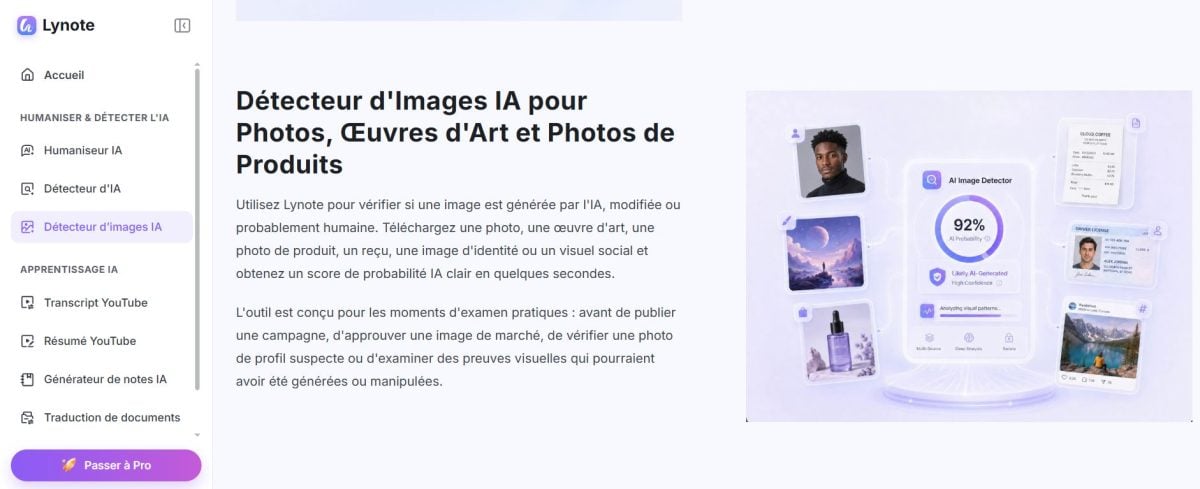
That's where Lynote.ai stands out.
Many detection tools do only one thing: they detect AI-generated text or images, but rarely both consistently. Lynote covers it all:
- AI text detection,
- AI image detection,
- and one humanization tool to improve AI-generated text, all in one place.
No need to switch tools, and no need to manage multiple subscriptions.
For the image detection In particular, the AI image detector Lynote analyzes your upload and returns a clear probability score: what is the probability that the image was generated by AI, along with a detailed confidence level.
It works with various file formats and handles everything from obvious cases to the most subtle ones—the kind that would fool most people at first glance.
The learning curve is low enough for everyday users. You don't need to know anything about machine learning.
- You Upload an image.
- You get a result.
- You know what you're dealing with.
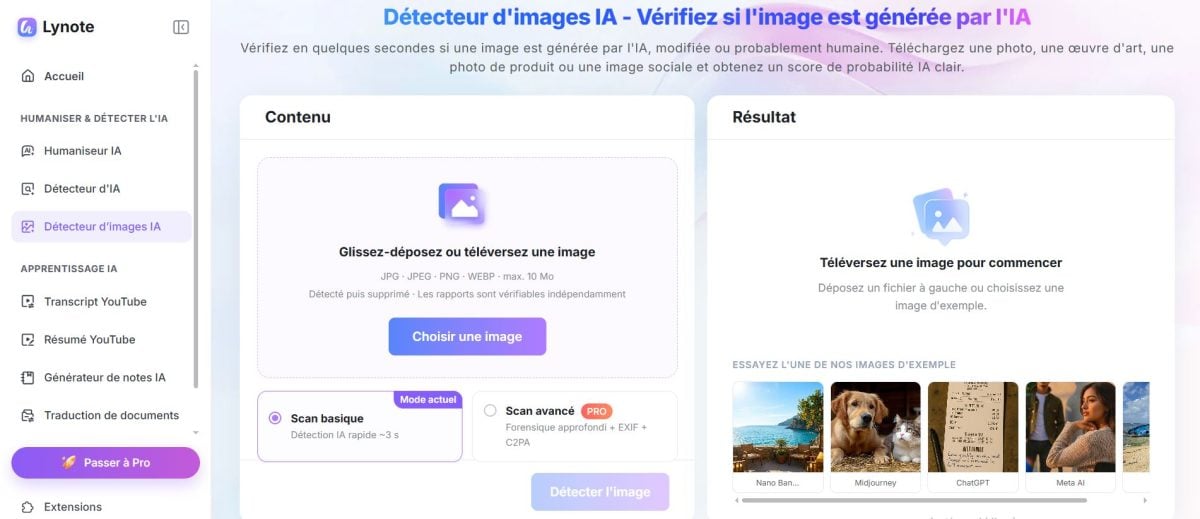
If you're a content creator who sources images from stock libraries or contributors, Lynote offers you a quick way to check what you're actually posting.
This is important for credibility, and increasingly for compliance with platform policies, as many networks are beginning to enforce policies regarding Disclosure of AI-Generated Content.
Why does this go beyond mere curiosity?
There is a version of this discussion in which AI image detection is merely a technical topic of interest. But the practical stakes are really much higher than that.
- Online trust is already fragile
When convincing hoaxes circulate in news articles, on social media, and in advertising, they erode something that is very difficult to rebuild.
For content creators and publishers, being associated with misleading images is a reputational issue that can easily be avoided with the right tools.
- There is also a growing regulatory aspect
The European AI Act (EU AI Act), which will take effect gradually in 2024 and 2025, includes provisions on transparency regarding AI-generated content.
Other jurisdictions are following suit. Recognizing AI-generated content is not just a matter of personal curiosity; it is increasingly a compliance requirement for organizations that publish content on a large scale.
- A Matter of Digital Responsibility
And at the most basic level, being able to verify what you're looking at is simply a good habit to get into.
Just as you would verify a source before sharing an article, checking whether an image was generated by AI is becoming a standard part of being a responsible digital media consumer.
Where should I start?
If you've never used a AI image detector Actually, the process is simpler than you might think.
With Lynote, go to the image detection page, upload the image you want to check, and wait a few seconds for the result.
✅ No complicated setup, no account required for basic use, and the results are clear enough to understand without any technical training.
A good way to gauge your understanding is to test the tool on images that you're already certain of: one clearly generated by a tool like Midjourney and one that you took yourself.
By seeing how the tool responds to both, you'll have a useful point of reference for interpret confidence scores when you check something that seems uncertain to you.
From there, it becomes a habit. Not something you do for every image you come across, but something you fall back on when it matters: when you source content, verify a statement, or when something doesn't seem right to you not quite right and you want to know why.
✅ The tools to navigate this world exist. The question is simply whether you use them.
If you're interested in this topic and would like to learn more about Verification of Your Content, be sure to check out our additional guides:






 FR
FR  RU
RU  EN
EN  ES
ES  IT
IT  DE
DE  ZH
ZH  PT
PT  ID
ID  JA
JA  DA
DA
One thing to keep in mind is that visual clues alone are becoming much less reliable as AI-generated images become more realistic. An AI image detector can serve as a useful additional layer of verification when you’re unsure about an image, especially for content you plan to publish or share.
Hi Darius, exactly! That’s precisely what makes verification more and more challenging every day. AI detectors provide a valuable safety net, even though they should always be used in conjunction with a healthy dose of critical thinking about the context. Thanks for sharing your thoughts!