To determine whether a text was written by ChatGPT, there are two approaches: manually identifying characteristic signs (repetitive style, generic phrasing, lack of precision) or pasting the text into an online detection tool such as Lucide, Smodin, or Scribbr. Neither method is 100% reliable, which is why it’s best to combine them.
In this article, we explain how to tell if a text was generated by artificial intelligence, with concrete examples of typical sentences and a detailed overview of the best AI detectors. We also discuss how ChatGPT works, the actual reliability of detection tools, and the impact of AI-generated content on SEO.

Why would anyone want to detect text written by ChatGPT?
Before we look at how to detect AI-generated text, it’s helpful to understand why this question comes up so often. Since the rise of ChatGPT, it has become very easy to create text content in a matter of seconds, which raises issues of transparency and trust in the digital world.
Here are the specific reasons why it is essential to know whether a text was written by artificial intelligence:
- For teachers and graders: Detecting text generated by ChatGPT makes it possible to verify that an assignment was actually written by a human and not copied and pasted from an AI tool.
- For SEO and websites: Publishers want to ensure the reliability and authenticity of their content, because text generated without proofreading may contain errors.
- For recruiters and professionals: Knowing whether a text comes from ChatGPT helps assess the authenticity of an application or an article.
- For transparency: More and more internal policies require that the use of artificial intelligence in writing be disclosed.
Now that we've established these reasons, let's move on to a practical method for determining whether a text was generated by AI.
1. Identify text generated by AI based on certain indicators
The tool developed by OpenAI is useful for many tasks, but text generated by ChatGPT often has identifiable limitations: a lack of depth, accuracy, or originality. Recognizing these signs can then help you humanize a ChatGPT text to make it look more natural.
How ChatGPT Works (and Why It Leaves a Trail)
ChatGPT is a language model (a GPT, short for Generative Pre-trained Transformer) trained on millions of text data points from the web. To generate a response, it predicts the most likely word following each preceding word. This statistical approach explains why AI-generated texts tend to be bland, predictable, and repetitive: the algorithm always favors the «most average» phrasing—the one that appears most frequently in its data.
It is precisely this behavior that leaves detectable traces, both to the human eye and to detection tools. Models like GPT-4 are designed to produce coherent responses, but that very coherence becomes a telltale sign: the generated text is too polished, too consistent, and too predictable to be entirely human.
Lack of in-depth knowledge of ChatGPT
Like all artificial intelligence models, ChatGPT is trained on a database that is limited in scope. As a result, the text it generates may lack detail or expertise on specific topics, which can result in:
- Superficial or incomplete information: Content generated by artificial intelligence does not always provide relevant details.
- Factual errors or misinterpretations: ChatGPT often makes mistakes when it comes to recent, little-reported, or niche topics.
- A lack of perspective and analysis: Sometimes the text amounts to nothing more than a simple summary, without any point of view or in-depth analysis.
This limited database also causes ChatGPT to generate similar—or even redundant—text across different topics. This results in:
- Excessive use of clichés and stereotypical phrases, which makes text generated by AI sound artificial.
- A lack of creativity: Based on existing data, ChatGPT does not offer any new ideas.
- A lack of personality and style: The generated texts are less engaging to read.
Concrete examples of typical ChatGPT sentences
The best way to spot text written by ChatGPT is to recognize its linguistic quirks. Here are some phrases that recur frequently in AI-generated content, along with their human-written equivalents:
- AI Text: «It is important to note that ChatGPT has certain limitations.»
Human : «ChatGPT regularly gets dates and numbers wrong.» - AI Text: «In conclusion, it should be emphasized that this tool offers many advantages.»
Human : «Conclusion: practical, but needs to be monitored closely.» - AI Text: «In today's ever-changing world, technology plays a vital role.»
Human : «Technology is advancing quickly, and everyone is scrambling to keep up.» - AI Text: «Let's dive into this fascinating world together.»
Human : «Let's get right to the heart of the matter.» - AI Text: «It is essential to consider the various aspects of this issue in order to determine the best possible approach.»
Human : «Before making a decision, it's best to see what really works for you.»
Phrases such as «it is important to note,» «in short,» «let’s dive into,» «it is worth noting,» and «in a world where» are very common markers in AI-generated text. Spotting these phrases makes it possible to quickly distinguish an AI-generated text from one written by a human, without even needing to use a detection tool.
ChatGPT's impersonal and repetitive writing style
ChatGPT generates grammatically correct text, but it consists of generic words that lack personality. It also often repeats the same ideas or phrases, which detracts from the article’s flow. Here is a summary table of the differences between text generated by ChatGPT and text written by a human.
| Features | AI Text | Human-written text |
| Writing Style | Impersonal and repetitive | Personalized and original |
| Choice of words | Generic words and expressions | Varied and expressive vocabulary |
| Sentence Structure | Monotonous, often long | Varied |
| Sentence length | Sometimes too long | Short and Long Alternation |
| Transitions | Repetitive linking words | Natural and fluid |
| Vocabulary | Generic, sometimes technical | Adapted to the context |
| Personal Experience | Absent | Present, true stories |
Unlike content generated by ChatGPT, a text written by a human doesn’t follow a set outline from start to finish: it builds a connection with the reader, varies the pace, and weaves in personal touches. If you use an AI tool to generate content, proofread and revise the text to give it a more human style.
Factual and temporal inconsistencies
ChatGPT can generate incorrect information, especially on recent or complex topics. Here are the most common inconsistencies found in text generated by artificial intelligence:
- Anachronisms: details that are inconsistent with the time period in question, such as technologies or events that did not yet exist.
- Factual errors: incorrect dates, misspelled proper nouns, or inaccurate information.
- A lack of temporal consistency: The chronological order isn't always followed, which makes the text difficult to follow.
To minimize these risks, we recommend that you:
- Checking the veracity of information by cross-checking them with reliable sources.
- Don't rely on a single source and consult several official sources or experts on the subject.
- Use common sense: If a piece of information seems unlikely to you, do your own research to verify it.
2. Use an AI detector to identify text generated by ChatGPT
When manual analysis isn't enough, AI detection tools step in. Simply copy and paste text into an online detector to find out in a matter of seconds whether it was generated by ChatGPT. Here are the three tools we use and recommend at Alucare.
What is an AI text detector?
An AI text detector is a tool capable of analyzing text to determine whether it was written by an artificial intelligence model such as ChatGPT. These detection tools are based on two main principles:
- Perplexity: It measures how predictable a text is. AI-generated content is highly predictable (low perplexity), because the model always chooses the most likely word.
- Burstiness: Humans alternate between short and long sentences in an irregular pattern, whereas AI produces a more consistent rhythm.
By combining these syntactic and semantic analyses with machine learning, the detector assigns a score indicating the probability that the text was generated by AI. Some tools provide only an overall score, while others highlight suspicious passages to help you analyze the text sentence by sentence.
Lucide: The Most Effective AI Detector (Our Recommendation)
Lucide is the detection tool we recommend first and foremost at Alucare, after testing it on numerous articles. It works in French, quickly analyzes generated text, and provides a highly accurate AI probability score. What sets it apart from other detectors is that it highlights suspicious passages directly in the text, allowing you to see exactly which sentences were generated by AI and which were written by a human.
Lucide is available in a free version (with a limited number of words per day) and a premium version for unrestricted professional use. It’s the solution we use to check our own content before publication.
Try Lucide for free
Smodin: a free, multilingual detection tool
Smodin is a free AI detector with a premium version, available in several languages, including French. It’s useful for quickly checking a short text before publication. The tool analyzes the generated content and assigns a probability score, but its analysis is less accurate than Lucide’s when it comes to French texts.

Scribbr: Ideal for Academic Writing
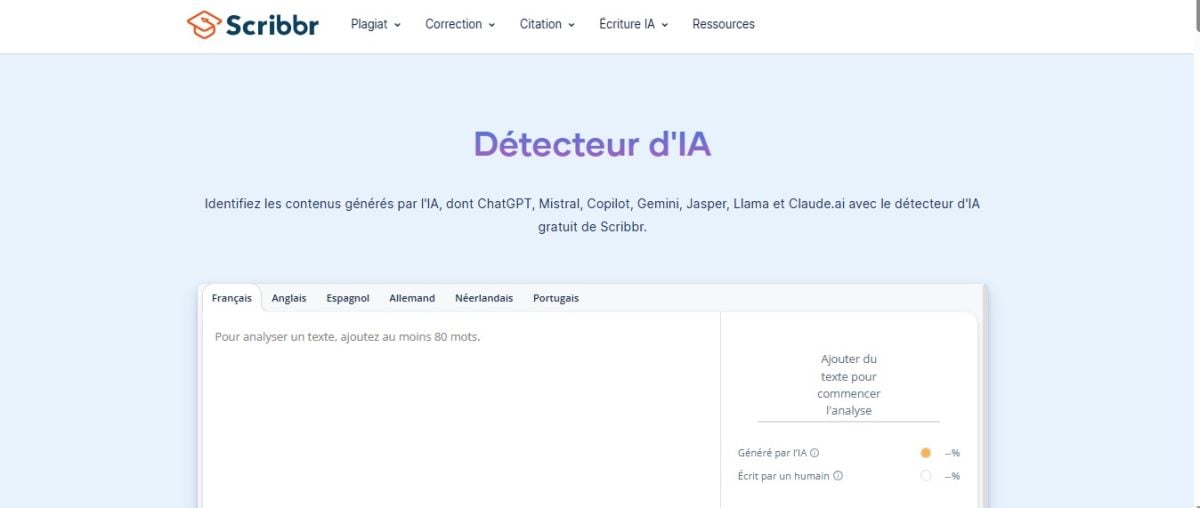
Scribbr offers a free AI detector for up to 1,200 words per submission, with a French interface and support for English, Spanish, and German. It is particularly well-suited for students and professors who want to check whether an academic text was written by AI or by a human. For large volumes of articles, however, its free limits quickly become restrictive.
Other tools, such as ZeroGPT, are very popular, but their reliability is often called into question: they produce many false positives (human-written texts classified as AI-generated). Use with caution.
How do you use an AI text detector?
It's easy to use and takes only a few seconds, no matter which option you choose:
- Go to the website of the plagiarism detection tool you've chosen (Lucide, Smodin, or Scribbr).
- Copy and paste the text you want to analyze into the designated field.
- Run the analysis and wait for the results.
- Read the detection score and, if the tool offers this feature, identify the sentences highlighted as having been generated by AI.
The results typically indicate a probability percentage that the text was generated by artificial intelligence, sometimes accompanied by a detailed, sentence-by-sentence report.
Detect AI-generated text with LucideAre AI detectors 100 % reliable?
No, and this is a crucial point to understand. No AI text detector is 100 % reliable. Independent studies (such as Weber-Wulff et al., 2023) show that the actual accuracy of these tools is often less than 70 %, far below the rates claimed by the publishers themselves.
There are several important limitations to keep in mind:
- False positives are common: Text written by a human may be flagged as AI-generated, which can have serious consequences (such as an unjustified accusation against a student, for example).
- Detection fails if the text is rephrased: Content that has been generated and then slightly revised often goes unnoticed.
- Texts in French or written by non-native speakers are penalized more heavily, with higher error rates.
The logical conclusion: use detectors as a tool, never as definitive proof. Manual detection (the signs mentioned above) remains an essential complement for confirming a result. Lucide remains the most accurate detector we have tested on French texts, particularly thanks to its sentence-by-sentence analysis.
Does Google penalize text generated by ChatGPT?
Many people wonder about this when it comes to SEO. Google’s answer is clear: it’s not the source of the content (human or AI) that matters, but its quality. A text generated by ChatGPT, if it’s useful, accurate, and provides real value, can rank very well.
On the other hand, content generated en masse—without proofreading or added value—for the sole purpose of manipulating search rankings falls under Google’s anti-spam rules and risks a penalty. Best practice, therefore, is to use artificial intelligence ethically: generate a foundation, then verify the information, and add real-world experience and a human perspective.
For websites that publish a large number of AI-generated articles, using a detection tool like Lucide before publication makes it possible to quickly identify content that requires a thorough review before going live.
How Can We Use ChatGPT Ethically?
Using ChatGPT to write content isn't a problem in and of itself, as long as you follow a few simple rules. Here are the best practices we follow at Alucare:
- Use the generated text as a starting point, not as a final article. ChatGPT can generate a structure, ideas, or phrasing, but the text must then be revised by a human.
- Check all the information Check with reliable sources before publishing, as factual errors are common in user-generated content.
- Add a real-life experience: A personal opinion, a concrete example, or an anecdote makes the text more credible and engaging.
- Report the Use of AI when your editorial policy or that of your client requires it, in the interest of transparency.
- Analyze the final text using a detector such as Lucide to ensure that the published content will not be flagged as AI-generated.
It is entirely possible to blend text generated by ChatGPT with human-written text, provided that the text is thoroughly proofread and that the human contribution adds genuine value. A text generated entirely by a machine without any editing—even if it is grammatically correct—will always lack the precision and depth that characterize a text written by a human.
Conclusion
To determine whether a text was written by ChatGPT, there are two complementary methods: manually identifying telltale signs (generic phrasing, lack of precision, factual inconsistencies) and using a detection tool such as Lucide, Smodin, or Scribbr. Always keep in mind that no detector is infallible, and that your common sense remains the best filter.
Our recommendation: Start with Lucide, which offers the highest accuracy for French text and tells you exactly which sentences were generated by AI.
Try Lucide for freeMore articles on the’artificial intelligence are available on our website, including our guide to humanize a ChatGPT text. If you have any questions, feel free to ask them in the comments section.







 FR
FR  RU
RU  EN
EN  ES
ES  IT
IT  DE
DE  ZH
ZH  PT
PT  ID
ID  JA
JA  DA
DA