To find out whether a text is written by artificial intelligence (AI), two methods can be combined : spot signs with the naked eye (too smooth a style, impersonal tone, repetitions) and run the text through a online AI detector.
⚠️ A warning right away: no detector is 100 % reliable %.
Whether you want to check your own text before handing it in, or check someone else's (student, candidate, editor), we explain how to read a score correctly and avoid falling into the trap of false positive.
Recognizing text written by an AI: signs
There are several ways to detect text written by an AI. The methods are based on linguistic, stylistic or semantic criteria. Here are a few examples of these criteria.
In addition to detecting text written by AI, we also help by providing you with tips on how to’humanize a ChatGPT text à travers un autre article sur notre site.
1. Consistency
A text written by an AI can inconsistent, that is, logic and continuity in reasoning, structure or tone.
It can present contradictions, changes of subject or register, but also abrupt transitions.
2. Relevance
A text written by an AI can irrelevant It skims over the subject without getting down to the nitty-gritty. Here are the three signals to watch out for:
- ❌ Hollow generalities: “It's important to take several factors into account”, “This issue deserves careful consideration”.
- ❌ Factual hallucinations: names, dates, figures or quotes that sound right but don't exist (always cross-check sources).
- ❌ A lack of clear-cut opinion: the AI presents “both sides” all the time and avoids taking a position.
3. Creativity
A text written by an AI can lack creativity, i.e. :
- Originality; ;
- Personality; ;
- Emotion.
Artificial intelligence sometimes generates ready-made formulas, In contrast to texts written by human beings, they contain clichés, banalities and empty expressions.
4. A style that's too smooth (and not the other way around)
❌ Contrary to popular belief, the spelling mistakes are no longer a sign of AI recent models write near-perfect French.
The real signal is the opposite: a text too smooth, The text is uncluttered, with impeccable punctuation and sentences of equal length, with standardized transitions («In conclusion», «It's important to note that», «Furthermore»).
📌 Besides, some people deliberately insert typos into AI text to make it look human. A mistake is therefore no guarantee of authenticity.
5. Vocabulary
Text written by an AI often uses a boilerplate vocabulary, with words that come back over and over again:
- ❌ Empty adjectives: crucial, essential, fundamental, primordial, indispensable.
- ❌ Corporate verbs: optimize, exploit, leverage, highlight, navigate (in context).
- ❌ Drawing names: landscape, ecosystem, dynamics, synergy, issues.
📌 If a paragraph contains 3 of these words, it's a strong signal. No human naturally writes “navigating the dynamic landscape of critical issues”.
6. Repetitions
AIs loop around the same formulas. Repetitions to watch out for:
- ❌ The rhetorical triptych : “not only... but also”, “both... and”, systematically.
- ❌ Standardized transitions : In addition, En outre, Par ailleurs, En conclusion, often every 2-3 sentences.
- ❌ The perfect closing sentences: each paragraph ends with a mini-synthesis (“In sum...”, “Thus...”, “To sum up...”).
Humans vary their transitions naturally. Artificial intelligence doesn't.
How reliable are AI detectors?
Let's be honest: an AI detector does not render a verdict, it gives a probability.
👉 It sometimes classifies human 100 % text as «AI-generated», which is called a false positive.
👉 Conversely, slightly reworded AI text can pass for human (false negative).
Two limits to keep in mind:
- ❌ Paraphrasing breaks detection: a few manual reformulations are enough to bring down the score of an AI text.
- ❌ French is at a disadvantage: most detectors are trained on English-language texts. On French texts, false positives increase, especially on «clean» texts (corporate style, dissertations, professional reports).
📌 The golden rule depends on your profile:
- ✅ You check your own text (before you hand it in, before you publish it): cross 2 or 3 tools rather than relying on just one. If they all agree on «AI», it's a true signal. If only one says it, it's probably a false positive.
- ✅ You check the text of a third party (student, candidate, editor) : never accuse on the basis of a single score. The detector is a clue that requires verification: cross-reference several tools, then leave the final verdict to your human reading (consistency of style with the person's other writings, presence of rough edges, choice of words).
👌 To sum up: an AI detector is a a useful filter, not a judge.
Identifying AI-generated text: detection tools
There's a quick and easy way to detect whether a text is written by an AI and not a human writer. It involves using a online tool (AI content detector), which evaluates the quality, accuracy and authenticity of a text.
Using an AI content detector is a good starting point to identify AI-generated text such as ChatGPT, Rédaction.io, etc.
For writing tics specific to ChatGPTthis is how to detect that a text is written with ChatGPT.
Among the most popular detection platforms, we can mention :
- Smodin ;
- Lucide.AI ;
- Scribbr.
These AI detection tools allow you to quickly and efficiently check whether a text has been written by a human or an artificial intelligence.
After analysis, the tool then assigns a score which indicates the degree of confidence that can be placed in the text. Here's what you need to know about it.
| 🤖 AI detector | 🎯 For whom | ✅ Benefits | ❌ Limits | ⭐ Our opinion |
|---|---|---|---|---|
| Smodin | Editors (2-in-1 tool) | Detection + humanization integrated Comprehensive tools (plagiarism, writing, AI chat) |
More copywriting than detection Advanced features for a fee |
4,2/5 ⭐⭐⭐⭐☆ |
| Lucide.AI | Professional texts in French | Trained in French → fewer false positives in FR Integrated AI + plagiarism detection |
No free version Pay-as-you-go credit system |
4,8/5 ⭐⭐⭐⭐☆ |
| Scribbr | Students, dissertations | Free version available Multilingual support (FR/EN/ES/DE) Detailed reports |
Limited free version Premium quite expensive |
4,1/5 ⭐⭐⭐⭐☆ |
👌 Other internationally renowned detectors include: GPTZero (free, widely used by English-speaking students) and Originality.AI (the reference for SEO pros). They're less suited to pure French, but worth knowing if you work in English.
📌 Practical advice No single tool is perfect. For reliable results, cross-reference 2 or 3 detectors and compare scores.
If you're working with French, always add a French-trained tool (Lucide.AI or Scribbr) to your check.
1. Smodin
Smodin is an online platform for marketers, editors, journalists, teachers, recruiters and many others to detect texts written by an AI. It also offers’humanizing text.
To Smodin, The lower the score, the more likely the text is written by a human. The higher the score, the more likely the text is written by AI.
This tool is easy to use. You can check the authenticity of your text through these steps :
1. Copy, then paste text in the corresponding field on the platform.

2. Click on the Detect or Analyze button.
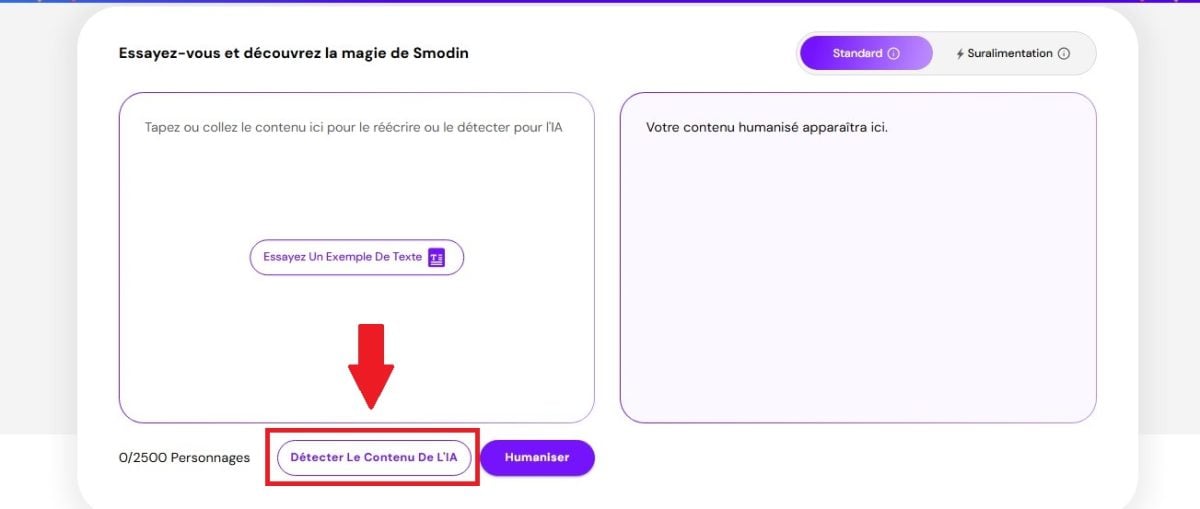
This tool offers paying packages that you can subscribe to if you want to take advantage of more features:
| 📦 Offer | 💰 Prizes | ✨ Benefits include |
|---|---|---|
| Starter | 10 USD /month (annually) |
|
| Bonus | 16 USD /month (annually) |
|
2. Lucide.AI
Lucide.AI is a AI detector which also offers online plagiarism detection. The solution is ideal for HR, SEO copywriting, education, etc.
To Lucide.AI, The higher the score, the more likely the text is written by a human. The lower the score, the more likely the text is written by AI.
As for Smodin, Simply copy and paste the text to be analyzed into the indicated field. Here, however, you'll need to check the’Artificial Intelligence option before pressing Detect.
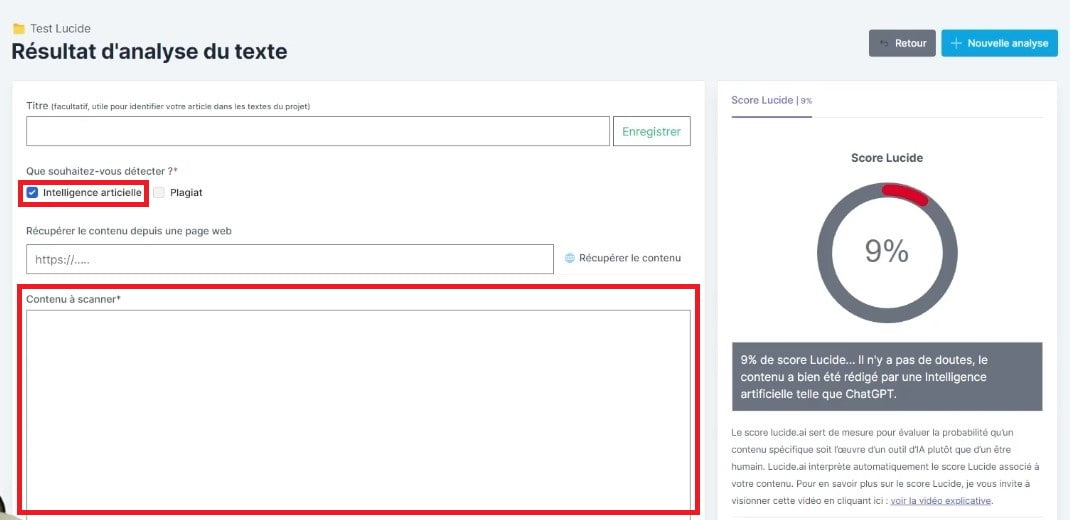
Here are the fee-based offers on this platform:
| 📦 Offer | 💰 Prizes | ✨ Benefits include |
|---|---|---|
| Discovery Pack Subscription | 6.30€ / month (€75.60/year) 0.063€ / credit |
|
| Abo Pack Essentiel | 18.90€ / month (226.80€/year) 0.049€ / credit |
|
| Advanced Pack Subscription | 32.90€ / month (394.80€/year) 0.049€ / credit |
|
3. Scribbr
Ideal for students, Scribbr offers advanced AI detection features and a plagiarism detection tool.
On Scribbr, The lower the score, the more likely the text is written by a human. The higher the score, the more likely the text is written by AI.
Its use is easy. The method is the same as for the above-mentioned tools:
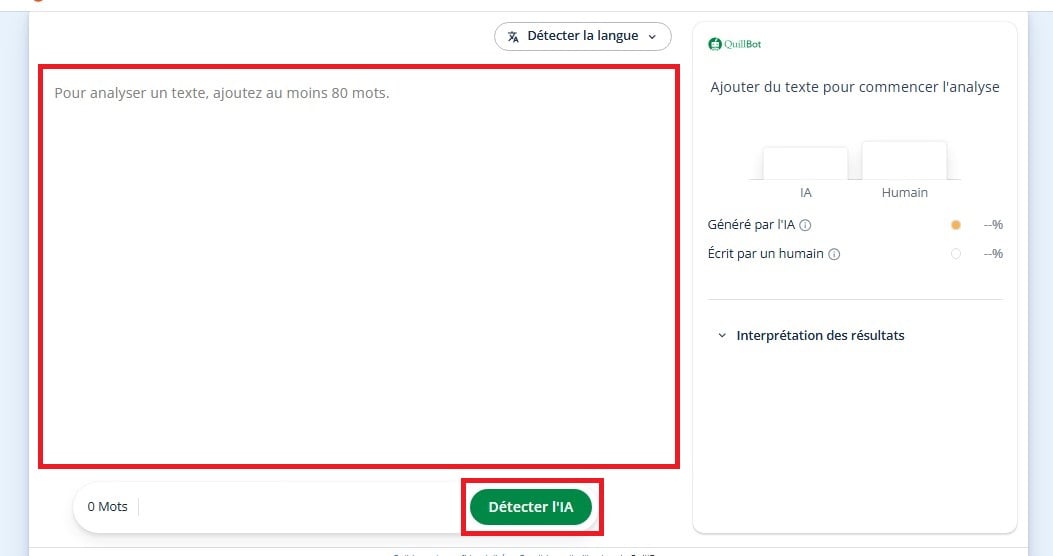
Here are the rates on this platform:
| 📦 Offer | 💰 Prizes | ✨ Benefits include |
|---|---|---|
| Basic detection | Free |
|
| Premium detection | From €14.95 |
|
The tools AI detectors There are many tools on the market to help you identify which parts of your content need to be edited. It's up to you to decide which one best suits your needs.
FAQs
Why use a third-party tool to detect text written by an AI?
Here are a few reasons to’opt for an AI detector :
- This is a very useful analysis tool for editorial professionals, who want to ensure the quality and originality of their texts.
- It's also a handy detection tool for readers who want to check the reliability and credibility of texts they consult.
- This type of tool is easy to use, This makes it possible to detect whether a text has been written by an AI such as ChatGPT or others.
Are there any rules governing AI-generated content?
The rules are still unclear when it comes to the use of AI-generated content. While most AI-generated content is harmless and useful, some practices are unethical.
👉 In Europe, the AI Act will impose a transparency requirement starting in August 2026: AI-generated content must be identifiable as such, particularly in professional and media contexts.
As a reminder, the results generated by artificial intelligence in the form of text, audio, images and video.
Is AI-generated text considered plagiarism?
Well, not exactly. Strictly speaking, plagiarism consists in copying an existing source without citing it. AI-generated text is not plagiarism in this sense: it has not been copied from a specific author.
On the other hand, it poses a problem of authenticity and integrity, which are equally sanctioned in academic or professional settings.
That's why a AI detector is not an anti-plagiarism tool: they address two different issues (see table below).
📌 For students: avoid AI-generated content in a thesis or assignment, unless explicitly authorized by your professor.
Which projects can be scanned with an AI detector?
You can scan several different documents with one AI detector. These range from professional and academic projects to blog posts. Here are a few details on the possible uses of this type of tool.
| 🎯 Type of project that can pass under an IA detector | 📑 Details |
|---|---|
| Professional projects |
|
| Blog posts |
|
| Research documents |
|
| In-class homework |
|
What's the difference between an AI text detector and anti-plagiarism software?
Detecting AI-generated text is different from detecting plagiarism in content. Here are the differences between an AI detector and anti-plagiarism software.
| 🔎 AI detector | 🧐 Anti-plagiarism software |
|---|---|
|
|
In conclusion :
- AI is increasingly being used to generate texts in various fields, with varying results in terms of quality and compliance with language rules.
- Regarding the criteria such as coherence, relevance, creativity, style and vocabulary, distinguish texts written by an AI from those written by humans.
- Online tools (AI detectors) are used to assess whether a text is produced by an AI, providing a score indicating the probability that the text is generated by the AI or written by a human.
- Thanks to an AI detector, you can check your content and ensure that readers receive texts that authentic, reliable and interesting.
Identify a text written by IA is simple if you have the right tools and know how to spot certain signs.
If you have any questions, don't hesitate to ask us in the comments section!







 English