the MMR (Matchmaking Rating) is the hidden score who decides who you play against in ranked on Valorant. It is distinct from your visible rank and RR displayed after each game.
If your MMR is higher than your rank, you earn more RR You gain more in a win and lose less in a loss. It's this connection between MMR and RR that drives your entire progression.
Valorant's MMR system
An invisible metric that assesses players' skill levels
the MMR (Matchmaking Rating) is a hidden score that measures your true skill level in Valorant. You can't see it directly in the game, but it's what drives the entire matchmaking system. It determines which opponents you play against and the team compositions in Competitive mode.
The purpose of this system It's simple: to create balanced matches. Riot Games doesn't show your MMR, but it's based on your performance in ranked games. It's the system that reflects your actual level, not just your displayed rank.
The main role of the MMR in Valorant is to determine how much RR (Rank Rating) you gain or lose at the end of a match. This calculation depends mainly on your win rate against players of a similar skill level.
What Really Affects Your MMR
Riot does not publish the exact formula for the calculation. What we do know is that the match result remains the deciding factor. Here are the factors that have the greatest impact on your MMR :
- The victories and losses: that's by far the number one factor.
- The regularity Over a series of games: winning multiple times in a row raises your estimated level faster.
- Your individual performance (the’ACS) : It only plays a minor role, serving as a slight adjustment to RR, and mainly in very close games.
Beware of a persistent misconception: your headshot rate is not included in the MMR calculation. To make lasting progress, the best approach is still to play regularly and to win your games.
The Difference Between MMR and RR
This is the point that confuses most players. The MMR is the hidden score that reflects your true skill level. The RR shape your visible rank, the one you see after every game. The two are connected, and understanding that connection means understanding how to move up in the rankings.
For each rank, your RR ranges from 0 to 100. A win usually earns you between 10 and 50 RR points. A loss costs you 10 to 30 points. The exact amount depends on the difference between your MMR and your displayed rank.
Here's how this convergence mechanism works:
- If your MMR is higher At your rank, you earn more RR for wins and lose less for losses. The game considers you to be underranked and helps you climb quickly.
- If your MMR stands for At your level, your RR gains and losses remain roughly balanced.
- If your MMR is lower At your rank, you earn fewer RR points when you win and lose more when you lose.
It's this system that raises your rank to your true level, season after season.
The ranking system in Valorant
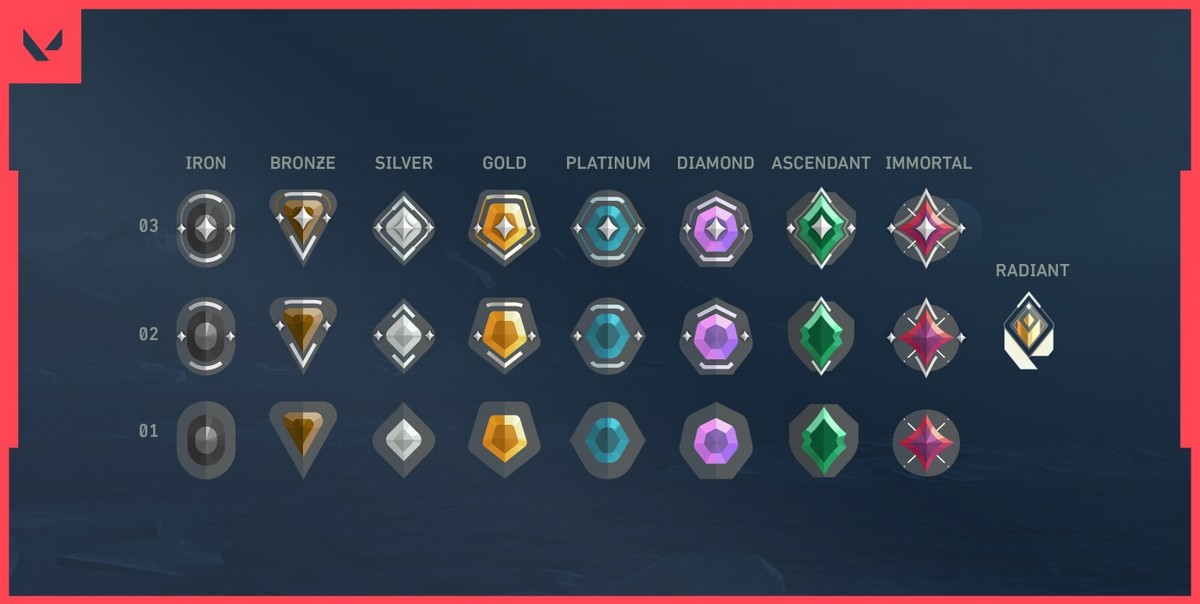
the Valorant Rankings is based on 9 rows. These ranks are used to measure your skill level and match you against opponents of similar skill. The goal of Riot Games It's simple: to ensure a balanced, competitive match in each game.
Your visible rank is displayed to your teammates during the game. Just open the menu tab to see the scoreboard and each player's rank.
Each row (except the Radiant) counts 3 levels. Level 3 is one level higher than Level 1. Here are the ranks, from lowest to highest:
- Fer : the introductory level. Players learn the game's basic mechanics.
- Bronze : a general understanding of the game, but still a lot of room for improvement in positioning and aim.
- Argent : above-average skills. Players incorporate a bit more strategy and teamwork.
- Or : a good sense of the game and the ability to manage multiple agents. Communication remains the main weakness.
- Platine : good teamwork and the ability to read the rounds correctly.
- Diamant : an advanced tactical approach, featuring polished site implementations and well-placed utilities.
- Ascendant : the level that prepares athletes for the very highest level. Discipline and timing make all the difference.
- Immortel : highly skilled players. This is the tier where competitive play on par with the esports scene becomes common.
- Radiant : the top tier, reserved for the best players on the servers. Exceptional skills and a thorough understanding of strategies for Valorant.
How to Unlock Competitive Mode
Competitive mode isn't available right from the start. You must first reach a sufficient account balance. Next, you'll need to fill out several unclassified parts to show that you've mastered the basics.
Once these conditions are met, you play your investment portions. They give to Riot They provide an initial assessment of your skill level and determine your initial visible rank. After each new season or major reset, you'll go through these placement matches again.
Rank Distribution in Valorant
Here is a rough breakdown of the ranks. These figures vary by season and patch.
| Rank | Percentage | Rank | Percentage |
| Iron | Platinum | ||
| Iron 1 | 0,8% | Turntable 1 | 4,6% |
| Iron 2 | 2,4% | Platinum 2 | 3,9% |
| Iron 3 | 6,0% | Platinum 3 | 3,5% |
| Bronze | Diamond | ||
| Bronze 1 | 6,1% | Diamond 1 | 3,2% |
| Bronze 2 | 8,8% | Diamond 2 | 2,5% |
| Bronze 3 | 8,0% | Diamond 3 | 1,8% |
| Silver | Ascendant | ||
| Silver 1 | 9,9% | Ascendant 1 | 1,2% |
| Silver 2 | 8,2% | Ascendant 2 | 0,6% |
| Silver 3 | 8,4% | Ascendant 3 | 0,3% |
| Gold | Immortal | ||
| Gold 1 | 7,7% | Immortal 1 | 0,2% |
| Gold 2 | 6,2% | Immortal 2 | 0,1% |
| Gold 3 | 5,2% | Immortal 3 | 0,1% |
| Radiant | 0,01% | ||
Understanding how the MMR and classification, that's the first step to making rapid progress on Valorant. To take it a step further and make aiming easier, check out our best crosshairs and their codes to copy.








 English