In The Witcher 3: Wild Hunt, the Gwynt (Where Gwent in English) is much more than just a mini card game.
This is a real strategy game in which players take part in friendly duels or even tournaments.
Your goal? Collect the 199 unique cards which are scattered across the continent. Find out everything you need to know about the game of Gwynt in The Witcher 3.

What are the basic rules of Gwynt?
Gwynt is a clever card game whose main objective is to outwit your opponent in terms of strategy and resource management. To master this pastime so dear to Geralt of Rivia, it is essential to understand the basics.
Gwent objective
To win a game of Gwynt, you must end the round with a total unit strength greater than that of your opponent on the battlefield.
Each unit card has a number representing its power. The sum of these numbers is the score of the round for each player.
Gwynt victory conditions
A game of Gwent on The Witcher 3 consists of several rounds. The first player to win two rounds is declared the winner of the game.
Playing Gwynt requires good risk management, a bit like playing poker. casino. It is therefore crucial to know when to persevere in order to win a round and when to pass your turn in order tosave valuable cards for subsequent rounds.
What's it like to play Gwent in The Witcher 3?
A game of Gwynt takes place in several stagesfrom preparing your deck to placing your cards on the battlefield:
1. Building your deck
Before getting started, you need to compose your deck. This must include :
- Regarding the unit cards,
- Regarding the special cards,
- A faction leader.
Keep in mind that quality is more important than quantity:
- Aim for a minimum of 22 unit cards. to increase your chances of getting the best cards in your starting hand.
- Avoid overloading your deck with cards too weak to optimize your strategy.

2. Card distribution
At the start of the game, both players will draw an equal number of cards (usually 10).
This is your starting handIt's up to you to manage it skilfully throughout the rounds.
3. Placement of unit cards
In turnYou play a card from your hand on the battlefield.
Unit cards are placed on one of the three lines available :
- Line from melee which is represented by a sword.
- Line from distance which is represented by a bow.
- Line from headquarters which is represented by a catapult.

Recall : Each line can be influenced by bonuses, maluses or weather and ability cards.
4. Managing your hand and special cards
During a game of Gwynt, managing your hand is crucial. Each card played is one less resource.
Special cards can completely change the course of a round.
- The weather charts, such as "Biting Cold" or "Impenetrable Fog," affect entire rows on the board.
- The effect cards can influence the course of a round. They often have an immediate effect and are then discarded.
Mastering the use of these special cards is the key to victory. In addition, don't hesitate to "pass" your turn if the round seems lost.
By acting strategically, you can store your most important cards for subsequent rounds.
What are the different types of cards in Gwynt?
Gwynt is distinguished by its card diversity and the uniqueness of its factions, each offering unique strategies and opportunities.
To build a high-performance deck and master the subtleties of Gwynt, you need to know the different types of cards and their functions :
Chef's cards
Each faction has its own set of unique Chef cards. Each Chef card offers a special power that can activated once per game.
This action enables :
- Either from turn a situation around.
- Either from reinforce an established strategy.
Unit cards
These are the fundamental cards in your deckThey are positioned on one of the three battle lines on the board:
- Line of scrimmage : For units fighting closest to the enemy.
- Remote line : For archers and other ranged units.
- Seat line : For war machines and heavy artillery.
Recall : Each unit card has a strength value that contributes to your line's total score.
Effect cards
These non-unit cards are intended to directly influence the course of the game. They can:
- To strenghten your own or your opponent's units (positively or negatively).
- Destroy specific cards belonging to the opponent.
- Edit certain rules or abilities of cards already played.
Weather maps
This is a category specific to effect cards. Weather cards aaffect all units in a given line (scrum, distance or siege) for both players.
For instance : “Biting Cold” reduces the strength of all melee units to 1, “Impenetrable Fog” does the same for ranged units, and “Pouring Rain” does the same for siege units.
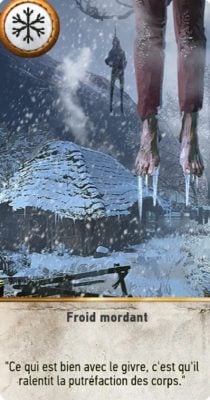


Weather maps are crucial for counter strategies based on accumulating numerous units on a single line.
What are the Gwent factions in The Witcher 3?
Before starting a game of Gwynt, remember that each faction has its own style of play, its unique powers, and a set of exclusive cards. In addition to being distinct, they offer varied strategic approaches.
Neutral cards
Neutral cards are essential for every deck and can be used with any faction.
They often include high-powered units (such as Avallac'h, Ciri Fiona Elen Rianno, or Geralt of Rivia) or universal effect cards.
Neutral cards are used to fill the gaps in a deck or reinforce its strengths.
Northern kingdoms
This faction is often characterized by its ability to group units and activate seat machine skills.
Leaders such as Foltest, John Natalis and Vernon Roche support number-based strategies and unit synergy.
Nilfgaard
Nilfgaard emperors and generals prioritize game control and informationThis faction is known for its frequent use of spy cards.
These spy cards, although they increase the opponent's strength, allow you to draw additional cards, offering a considerable advantage in terms of resources.
Their leaders, such as the variations of Emhyr var Emreis, as well as cards like Albrich or Fringilla Vigo, illustrate this approach.
Scoia'tael
This faction, focused on agility and versatility, often allows units to be placed on different lines or cards to be retrieved from the graveyard. Their abilities favor combos and surprise plays.
Monsters
The Monsters deck is known for its ability to summon numerous units in the field, particularly through cards that remain on the battlefield from one round to the next.
Their strength lies in their ability to overwhelm their opponents with numbers, ideal for aggressive strategies.
How do I get Gwent maps in The Witcher 3?
As a reminder, collect all 199 Gwynt cards in The Witcher 3: Wild Hunt is one of the most challenging side quests in the game, entitled "Catch 'Em All!"
To obtain Gwent cards, you can :
- Buy decks of cards or individual cards with merchants and innkeepers.
- Winning Gwynt games against NPCs for the first time.
- Obtain cards in the form of rewards from Gwynt-related quests.
Here's a tip: Make it a habit to save your game before facing a new player or participating in a Gwynt tournament. This will allow you to replay the duel in case of defeat and ensure you obtain unique cards.
the Gwynt in The Witcher 3: Wild Hunt is much more than just a hobby. It is a deep strategy game that rewards mastery of its rules, knowledge of its cards and factions, and diligent collecting.
By investing time in this mini-game, players enrich their experience of The Witcher universe and take on a stimulating challenge.
Do you like card games? Discover our articles on the subject:








 English