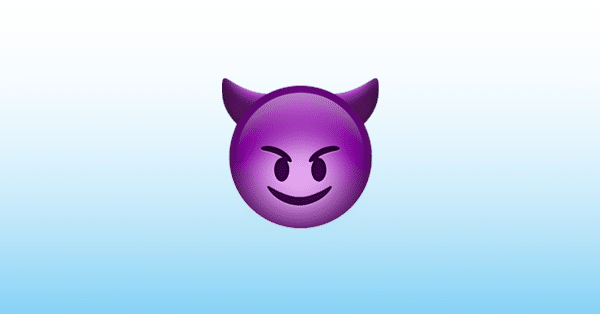
The emoji 😈 expresses a wicked smile and devious intentions. Depending on the context, it can convey a Machiavellian idea, a erotic innuendo, a playful little threat, a challenge, or sarcasm.
You can also find out more by clicking here are the 10 emojis that 9 out of 10 people misunderstand. And you, do you really know them?
To test your knowledge of emojis like 😈, you can take the quiz here :
😈 Meaning and examples of how to use the smiling emoji with horns
the smiling face with horns 😈 displays a a wide, sinister smile, eyes connected by furrowed brows and two black horns pointed on the head. The overall effect is a a sly, Machiavellian look, halfway between a threat and a joke. It's the direct cousin of the angry face with horns 👿, but with a smile instead of a pout.
You send 😈 to:
- report a sneaky idea or a ulterior motive
- to pass a malignant intent when faced with a situation or a person
- slide a erotic innuendo or suggestive
- throw a little playful threat or a challenge
- to express sarcasm or dark humor
When the person you're talking to uses it, the meaning depends on the context. With a close friend or family member, it's often a joke or a light-hearted flirtation. In a tense exchange, it can turn into provocation. Avoid it in a professional setting or with someone you don't know well: the diabolical sign can easily be misinterpreted.
Here are a few examples of how to use emojis in diabolical smile in a sentence:
- I will give you the worst day of your life 😈.
- You don't know me yet, you'll see 😈.
- I will come to your house on Saturday evening 😈.
The Origin of the Smiling Face with Horns Emoji
The 😈 emoji originated from a proposal submitted in 2009 at the Unicode Consortium. Its official name in English is Smiling Face with Horns, sometimes called Smiling Imp, which brings to mind the image of a mischievous little devil.
On the technical side, it runs on the code U+1F608. It was first approved in Unicode 6.0 in 2010, and then incorporated into the version Emoji 1.0, published on August 4, 2015. So this little rascal has been around for over ten years, and its meaning hasn't moved: the malice above all else.
The characteristics of this emoji
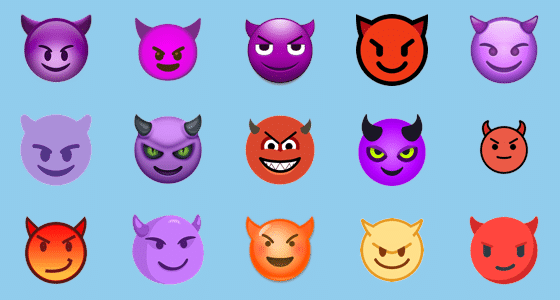
Be careful not to confuse this smiley with the’emoji angry face with horns 👿. The only real visual difference is in the mouth : THE Smiling Face with Horns displays a big smile, while the Angry Face with Horns shows a menacing pout. The rest (color, eyes, eyebrows, horns) remains the same, but the meaning changes completely.
As for color, forget about the "red devil" image. On the most platforms (Apple, Google, Samsung, Twitter/X), the smiling face with horns appears in violet, with black horns. Only Microsoft still has a classic red appearance.
| Version | Emoji 1.0 (August 4, 2015) |
| Usual name | Smiley face with horns |
| Category | Smileys and emotions |
| Sub-category | Negative aspect |
| Apple designation | Smiley face with horns |
| Unicode code point | U+1F608 |
| Decimal (HTML code) | ALT+128520 |
| unicode | 6.0 (11/10/2010) |
| Key words | Face, horns, smile, fantasy, mischief |
| Other names | Smiling Satan emoji, devilish smile emoji |
It's the gold standard 1F608 which allows you to view it in HTML, copy it, or embed it using a shortcode on the social networks.
You can also explore the meanings of the sulking emoji 😡 to compare expressions of anger.








 English
🤨🤨🤨🤨🤨
Hello, Assa. Does this comment mean that the explanation isn't clear, or would you like to know more about another emoji?