The 😧 emoji expresses’anxiety, the stress and the strong annoyance. There meaning of the emoji anxious expression 😧 depends on the context. You use it to react to shocking news or to express anxiety.
To test your knowledge of emojis like 😧, you can take the quiz here :
You can also check out The 10 emojis that 9 out of 10 people misunderstand—click here. Do you really know them?
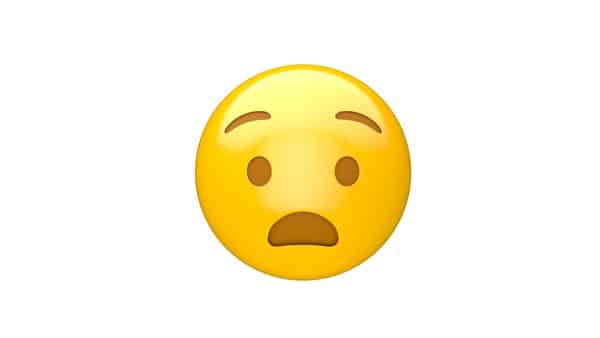
😧 Meaning and a few examples of how to use the distressed face emoji
Visually, you can recognize this emoji by its two small oval eyes, his furrowed brows slightly drooping and its open mouth in a semicircle. This frown accentuates the feeling of’anxiety. The ensemble conveys an expression that is both sad and confused, as an emotional state that seeks solace.
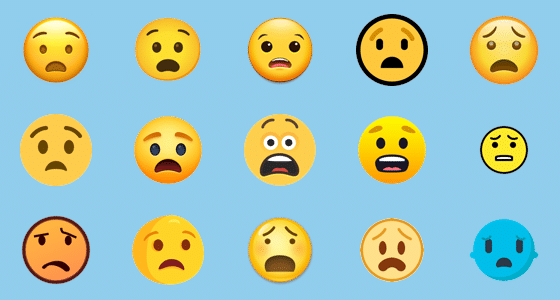
Its official name is «emoji" anxious expression ». On Google and Samsung, them eyebrows are slightly higher.
On Apple, Twitter and Microsoft, they are bent downward more. In any case, the emotions most often associated with this emoji are:
- the stress
- The fear and fear
- L'anxiety and anxiety
- The sadness
- The voltage
- The surprise
- L'anxiety
- The confusion
In practice, this emoji is easy to slip into a text message or a social media post. Here are a few concrete examples:
- That really scares me 😧.
- I have an exam tomorrow and I haven't even had time to study 😧.
- Tell me it's not true 😧.
- I'm a little lost right now; I don't understand anything anymore 😧.
- The meeting has been moved up to tonight 😧.
Emojis similar to 😧
The emoji anxious expression 😧 is often confused with other similar emojis. The unhappy face with a mouth 😦 It looks like him.
the a dejected face with a bead of sweat 😓 and the a sad but relieved expression 😥 also express a certain sense of distress. The a bewildered expression 😕 conveys a gentler sense of confusion.
The difference lies in the expression of the eyebrows and mouth. The anxiety expressed by 😧 is more intense than that of these similar emojis.
The Origin of the Worried Face Emoji
The 😧 emoji was first submitted to the Consortium Unicode in 2010, in a batch of 13 emojis presented together.
This proposal included several facial expressions to convey negative emotions, ranging from anxiety to sadness.
The proposal was approved, and the anxious expression has been officially integrated into Unicode 6.1 in 2012. The 😧 emoji and its neighbor, 😦, are part of the same proposal, given their similarity.
The anguished face then appeared in the version Emoji 1.0 in August 2015. It was this version that laid the foundation for the emojis you use today on most platforms.
The characteristics of this emoji
Here are the technical specifications for the’anxious face emoji 😧, with its code point, her Unicode version and its other names.
| Last name | anguished face |
| Unicode code point | U+1F627 |
| Decimal code | ALT+128551 |
| Unicode Version | 6.1 (January 31, 2012) |
| Emoji Version | 1.0 (August 2015) |
| Category | Smileys and emotions |
| Sub-category | Worried expression |
| Apple designation | anguished face |
| Related keywords | anxiety, face, worry, tension |
| Other names | An alarmed expression, a worried expression, a tense expression, an anxious expression |
That same line of code U+1F627 remains valid on all platforms (Apple, Google, Samsung, Microsoft, Twitter). The meaning The level of anxiety and worry remains the same everywhere.
You know everything there is to know about the 😧 emoji. Use it in your posts when words are no longer enough.








 English