The emoji 🙊 (Speak-No-Evil Monkey) represents a monkey who covers their mouth with one's hands. Its main meaning is the discretion : the refusal to speak, the choice to keep the silence or to avoid saying anything hurtful.
Depending on the context, it can also express the’embarrassment, embarrassment, or guilt.
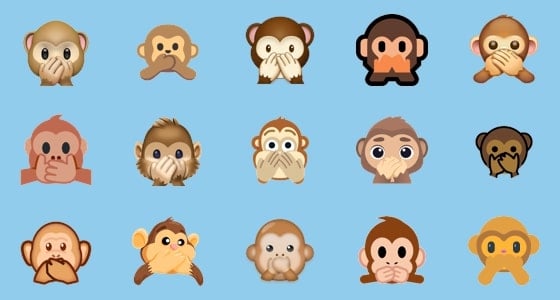
You can also find out more by clicking here are the 10 emojis that 9 out of 10 people misunderstand. And you, do you really know them?
To test your knowledge of emojis like 🙊, you can take the quiz here :
🙊: The meanings and uses of monkey mean nothing
The 🙊 emoji represents Iwazaru, the third of the monkeys of wisdom. His name literally means «the one who says nothing,» that is, who says nothing about badly : no lies, no prejudice, no gossip. It rounds out the Japanese trio consisting of Mizaru (there's nothing wrong with that) and Kikazaru (Don't take it the wrong way.).
It can be found at WhatsApp, Messenger and most couriers, often looking embarrassed.
What do the three wise monkeys symbolize?
Together, the the three wise monkeys illustrate the motto «see no evil, hear no evil, speak no evil» in the face of evil. It is a Japanese proverb old.
- Mizaru covers their eyes: to avoid seeing the bad stuff (🙈).
- Kikazaru covers his ears: so as not to hear the bad news (🙉).
- Iwazaru covers her mouth: don't say anything bad (🙊).
How and when should you use the 🙊 emoji?
In a message, the’monkey emoji 🙊 is mainly used in two situations:
- To express the discretion : You know how to keep a secret, or you don't talk about things that aren't your business.
- To show your embarrassment after a slip of the tongue: you talked too much or said something without thinking.
The tone varies depending on the context. On social media, it’s often humorous. In text messages, it softens a slip-up. Here are two concrete examples:
- «I'd rather not say anything 🙊» to let someone know you're keeping something to yourself.
- «I didn't mean to say that—oops 🙊» after a little slip-up.
Attention : in certain contexts, this monkey emoji is perceived as racist if it is sent in response to a Black person. This association refers to a historically offensive comparison. Use with caution, depending on the channel and tone of the message.
You can also combine 🙊 with a smiley with a smile and rosy cheeks 😊 to soften the tone of a message in which you apologize for being too forward.
Origin of the smiley monkey say nothing 🙊
This emoji has two origins: a recent technical history and a much older cultural root.
In terms of standards, the monkey say nothing has been standardized to Unicode 6.0 in 2010, under the code U+1F64A. It was then officially published in Emoji 1.0 the June 9, 2015.
But the real story begins long before emojis. This monkey emoji "muet" follows in the tradition of the three wise monkeys, a symbol of Japanese origin that is deeply rooted in Asian culture. It is this powerful image—hands pressed against the mouth—that explains why 🙊 is used so often today to express a a well-kept secret, an awkward moment, or a private conversation.
The characteristics of this emoji
Here are the technical specifications for the’monkey emoji 🙊 :
| Version | 1.0 (2015-06-09) |
| Usual name | monkey say nothing |
| Category | Smileys and Emotions |
| Sub-category | Face-Monkey |
| Apple designation | monkey who doesn't say anything bad |
| code point | U+1F64A |
| Decimal | ALT+128586 |
| unicode | 6.0 (2010-10-11) |
| Key words | monkey, mute, monkey says nothing |
| Other name | Silent monkey emoji, monkey emoji Iwazaru |
the Unicode name The official name for this face is Speak-No-Evil Monkey, or «the monkey who says nothing bad.» Its code U+1F64A allows you to identify it in all systems. You can also copy it directly from any messaging app.
Check out our other articles on smileys as well:









 English