The emoji 👺 expresses anger, dissatisfaction, or indignation. It allows one to react to an injustice, denounce a ruthless act, or express exasperation. But depending on the context, its meaning can vary: a warning, fear, Japanese folklore, or the world of masks and costumes.
You can also find out more by clicking here are the 10 emojis that 9 out of 10 people misunderstand. And you, do you really know them?
To test your knowledge of emojis like 👺, you can take the quiz here :
👺: The Meaning and Examples of Use for the Japanese Monster Emoji
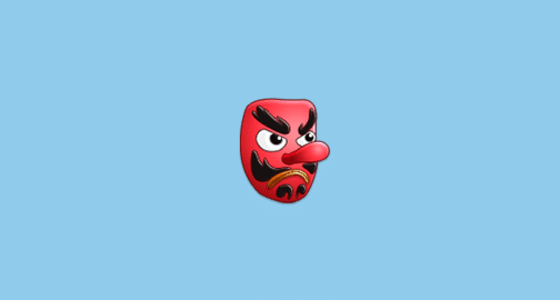
The emoji 👺 represents a tengu, a creature from the Japanese folklore, also known as Japanese monster emoji. Its meaning revolves around the anger, evil, and a cruel behavior, but it is also used to issue a warning or to refer to something supernatural.
It looks a lot like the’Japanese ogre emoji 👹, with the same expressive features derived from the Japanese culture.
It also belongs to the group of evil symbols, along with the devilish smile emoji 😈 and of the angry devil face emoji 👿.
In the world of masks and costumes, we also find it in the ghost emoji 👻 and the clown emoji 🤡.
What does the tengu emoji look like?
This emoji shows a menacing red mask with a grotesquely long nose. This long nose is a direct reference to the Shinto deity Sarutahiko Ōkami, considered the archetype of the red-faced tengu. It also depicts a mustache, of the thick, furrowed eyebrows, and two eyes with an extremely menacing gaze.
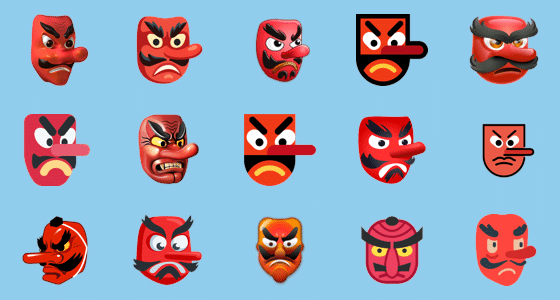
The appearance varies by platform. On Facebook, the tengu flashes a predatory smile with prominent canines. In naming Unicode Officially, it is called Japanese Goblin, using the code U+1F47A.
In what contexts should you use the 👺 emoji?
You can use it in a variety of situations:
- Express a moral outrage when faced with cruel or unfair behavior
- Launch a threatening warning
- Play the mischievous prankster on a lighter note
- To mention Halloween, costumes, or fantasy video game worlds
Here are a few examples of sentences where you can use it:
- Some people are truly ruthless 👺👺👺. I never would have believed that a human being could commit such an atrocity.
- But why did that man have to do that to that poor animal 👺👺?
- Watch out for this one—he's a real prankster 👺.
Origin of the smiley
The emoji 👺 was born out of two proposals made at the Consortium Unicode, first in 2007 then in 2009.
The first proposal (reference L2/07-257) was submitted by Markus Scherer, Kat Momoi and Mark Davis. The second (reference L2/09-026) was filed by the same authors, this time joined by engineers from’Apple and of Google. These two files contained more than 750 emojis to be encoded all at once.
The symbol was approved as part of’Unicode 6.0, published in October 2010. He then joined Emoji 1.0 the August 4, 2015, the date from which emoji keyboards began widely displaying it across all platforms.
Features of this Tengu emoji
Here is the table of technical specifications for the emoji Japanese monster 👺, with its code Unicode, its version, and its various names.
| Version | Emoji 1.0 (August 4, 2015) |
| Usual name | japanese monster |
| Category | Smileys and emotions |
| Sub-category | Face-suit |
| Appellation Apple | Goblin |
| code point | U+1F47A (to be copied) |
| Decimal code | ALT+128122 |
| HTML code | 👺 |
| Unicode | 6.0 (October 11, 2010) |
| Key words | monster, Japanese, tengu |
| Other names |
|
The easiest way to use it is to to copy enter the 👺 symbol directly, or type in its code Unicode U+1F47A. It also appears on the emoji keyboards of most devices.
Now you know everything about the tengu 👺: its origins in Japanese folklore, how to use it in your messages on Discord, Skype or elsewhere, and its technical specifications.
To continue exploring the range of emojis, you can also check out the meanings of the emoji ☠️ or counterbalance these threatening expressions with something much gentler, such as the smiley smile red cheek 😊.








 English