In addition to tools for generate content Using AI, there are also generators that enable voice cloning.
But how exactly does AI voice cloning work? And how can it be used to imitate someone's voice? Let's find out together. cloning functions and its various applications.
What are the best AI voice cloning tools?
Today, there are many tools available that allow you to cloning voices realistically thanks to AI. We have selected three platforms that are worth checking out:
- Vidnoz.com This solution stands out for its precise imitation and natural results.
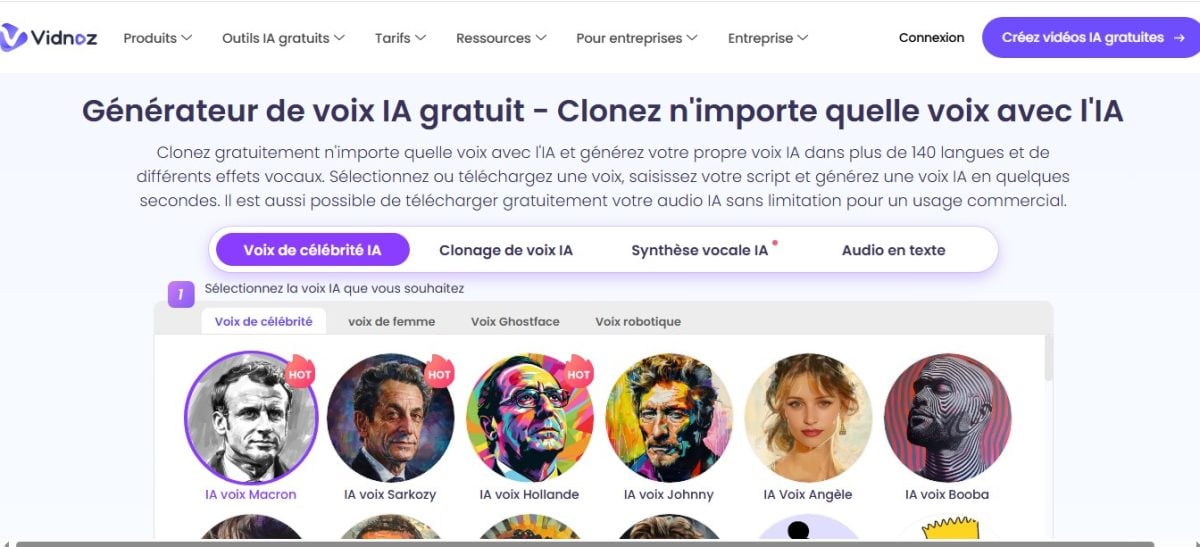
Want to know more? Read our full review at Vidnoz AI.
And with the coupon code Vidnoz Aiget 15% off all your Vidnoz AI subscriptions!
- Elevenlabs.io : This tool has the advantage of being easy to use. It offers voice cloning of several celebrities with customization options.

Discover our ElevenLabs review in this video:
Explanatory video in French by Alucare, ideal complement to the page. View video (you can use YouTube's automatic translation)

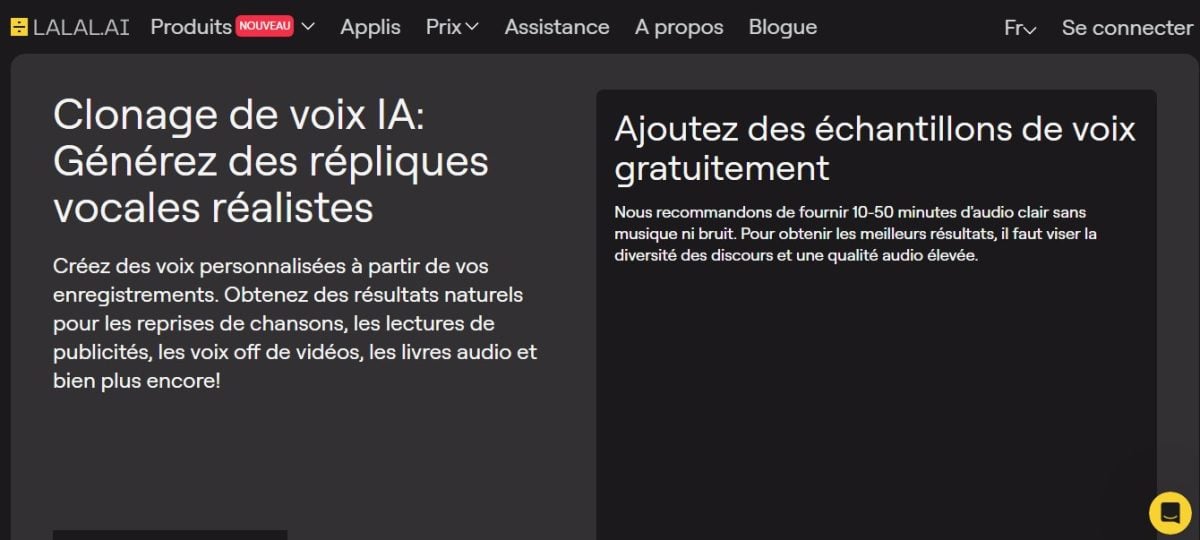
- Lalal.ai This AI provides a high-quality voice cloning service with an intuitive interface.
Notes:
- Each tool offers a free serviceBut this is limited, and the functionalities offered are fairly basic.
- the voice cloning applies to both audio and video files.
- These platforms also offer text-to-speech software or a AI voice generator with which you can easily transform text into audio.
What are the advantages and disadvantages of using voice cloning?
| ✅ Advantages of AI voice cloning | ❌ Disadvantages of AI voice cloning |
| Get content with a realistic voice | Forgery and identity theft |
| Restoring lost voices | Voices that sound artificial and lacking in emotion |
| Creating personalized content with unique voices | Invasion of privacy by cloning someone's voice without their consent |
| Information and services accessible to all | Spreading false information |
| Dubbing and voice-over more efficiently and cost-effectively | Ethical issues on the use of this technology |
| Creating fictional characters with unique, realistic voices | Potential cost |
AI-based voice cloning features

To imitate a voice, the voice cloning follows a number of stages:
- Collecting a voice sample: The latter must be sufficiently long and representative of the target voice to enable the AI to grasp its nuances and unique properties.
- Sample analysis: Artificial intelligence identifies key characteristics of the voice sample such as timbre, intonation, rhythm, pitch, and accent.
- Voice modeling : The AI then creates a vocal model based on the characteristics extracted from the sample. This model will be used to generate new sounds that match the target voice.
- The cloned voice generation: After following the previous steps, simply enter the text you want the voice-over to read, and the AI will generate the corresponding audio.
As mentioned above, there are many AI voice generators on the market. However, they must collect certain data to successfully imitate a voice.
What data is needed to mimic a voice with AI?
Having sufficient data in terms of both quantity and, above all, quality is necessary to ensure the success of thevocal imitation.
The longer and more diverse the voice sample, the better the AI will be able to identify the target voice nuancesThis will generate a faithful replica. Here are the necessary elements:
- The voice recordings The ability to recognize speech in different contexts allows artificial intelligence to learn its variables and adapt to different situations.
- The transcriptions of audio recordings help AI associate words with corresponding texts, which improves the accuracy of speech synthesis.
- The voice biometrics may include information such as fundamental frequency, format, and speech rhythm. This data allows AI to capture the finer aspects of the target voice.
What are the different voice cloning technologies?
- Voice deepfake uses machine learning to superimpose one person's voice onto another person's body or video.
- Voice synthesis creates an artificial voice from scratch based on rules and models of human speech.
- Voice cloning based on the vocoder enables voice analysis and synthesis for more accurate imitation.
What are the other features of AI voice cloning?
In addition to its main features, it is not uncommon for a voice cloning software offers other features such as:
- The converting text to voice : Generate an AI voice from text.
- the gender change voice : Transform a male voice-over into a female voice and vice-versa.
- Adding emotions: Generate a cloned voice expressing different emotions.
- The creation of hybrid voices : Modify the AI voice to create unique sounds.
- Adding effects: Create a more realistic or artistic sound.
- The background noise suppression : Clean up the audio for better sound quality.
- The voice translation : Translate a text from one language to another and have it read aloud by a cloned voice in the target language.
AI voice cloning software offers a wide range of possibilities for creating unique, personalized voices. So you can use them in a variety of fields.
When should AI voice cloning be used?

Voice cloning is a technology that is proving particularly usefulHere are some concrete examples of use cases:
Entertainment and media
- Dubbing and voice-over : Voice cloning can be used to create realistic voices for characters in movies, video games, animations, documentaries, and even social media ads.
- Creating personalized content : Thanks to this technology, you can generate your voice even if you are not available to record it.
- Voice restoration : AI voice cloning can also be used to restore the voices of deceased celebrities or people who have lost their voices due to illness or accident.
Education and training
- Language learning : Voice cloning generators can create voiceovers in different languages. But this technology can also be used to create voice tutors that can adapt to the pace and needs of each student.
- Audio books and narrative resources : This technology brings books and other educational materials to life, making learning more enjoyable and accessible to everyone.
- Customized teaching aids : Lessons, tutorials, or explanations can be created using the voice of a teacher or expert, making learning more interactive and personalized for students.
Accessibility
- Communication aids : AI is considered a valuable ally for people who have difficulty speaking or communicating. Thanks to voice cloning, they can generate synthetic voices based on their own voice or a chosen voice.
- Voice interfaces for the blind and visually impaired : Cloning a voice creates more natural, human-like AI voices for voice assistants, making them more pleasant and intuitive to use.
- Information accessible to all: This technology can also be used to generate audio versions of documents, websites, and other content.
Customer service
- Chatbots and virtual assistants : With more realistic voiceovers, you can enhance the customer experience and make interactions feel natural.
- Personalized messages and notifications : These can be read by cloned voices, making them more punchy and memorable for customers.
- Multilingual support : AI voice cloning makes it possible to offer customer support in several languages thanks to realistic voices, even local ones depending on the region.
As we have seen, the AI voice cloning is a promising technology with a wide range of potential applications.
However, you will need to use it responsibly and ethically to prevent abuse. In this way, you can maximize the benefits of AI voice cloning while minimizing the risks.
The solutions proposed in this article are easy to use and accessible to everyone. Choose the tool that best suits your needs.
The comment area is open to answer all your questions on the subject of voice cloning. If you need more content similar to this, check out our page AI.








 English