To remember:
Since golf is a precision sport, the equipment used to play it must be chosen sparingly. The ball plays the main role in this sport, so it deserves special consideration, particularly in terms of its weight. In our article, find the answer to the question: how much does a golf ball weigh ? and find out how to choose your golf ball and what the approximate market price is!
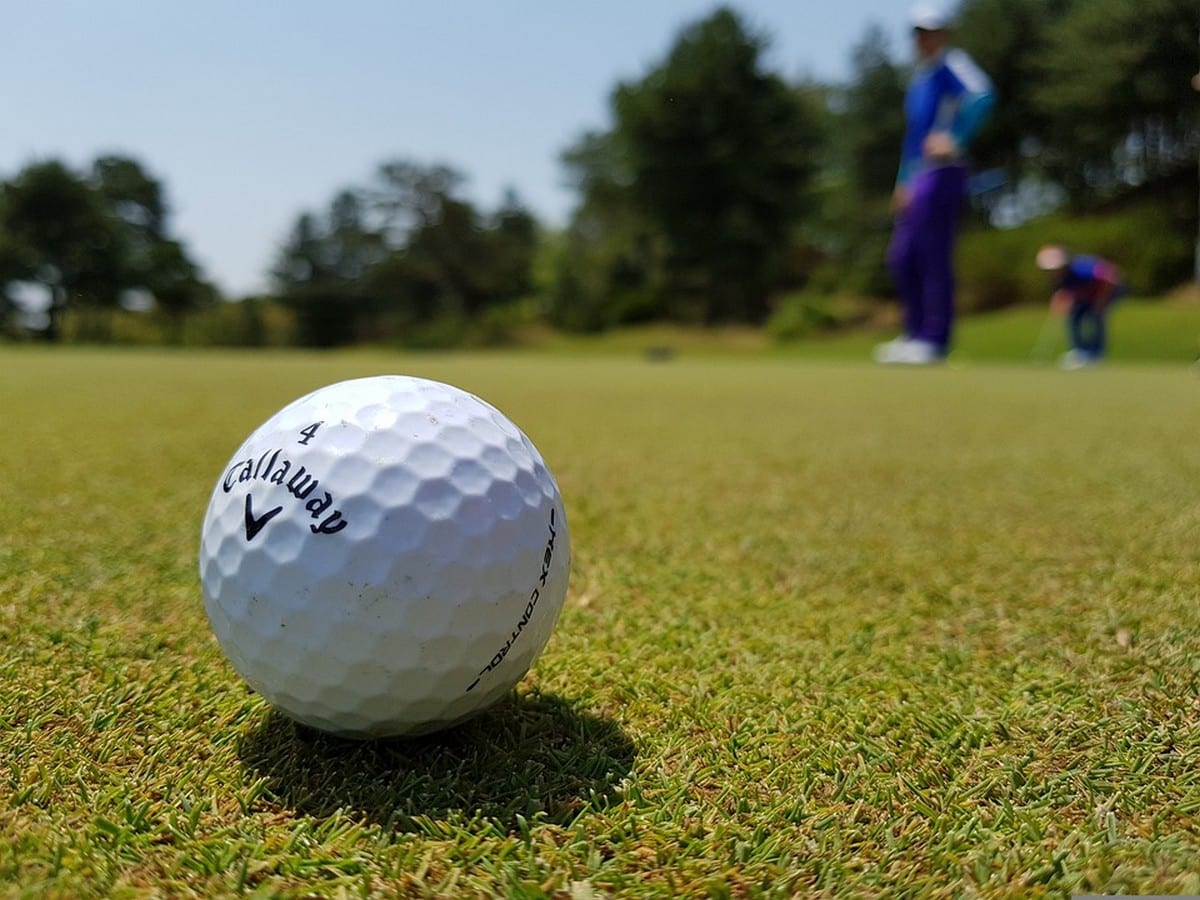
How much does a golf ball weigh?
With the materials it is made of and its honeycomb design, a golf ball weighs a maximum of 45.93 g. With this weight, the golf ball is the third smallest sports ball after the squash ball (first) and the ping-pong ball (second).
How big is it?
The USGA (United States Golf Association) regulates the size of golf balls. According to USGA rules, golf balls must have a diameter between 42.67 and 43.18 mmThe size of a golf ball is very important because it influences how the ball reacts when it is hit.
How much does a practice golf ball weigh?
Here are some details about practice golf balls:
For a single coin: the weight is 45.6 g + 0.3 g.
Here are some other features of the one-piece practice ball:
- Composition: usually rubber
- Diameter: 42.67 mm
- Elasticity: 73-78 %
- Number of cells: 350
- Coverage with a thickness of approximately 2 mm.
- Maximum ball speed is 262 km/h.
For a two-piece golf ball: weight 45.6 g + 0.3 g
Other interesting features:
- The material used is a rubber core and a DuPont Surlyn coating—of excellent quality.
- Diameter: 42.67 mm
- Elasticity: 75-80%
- Number of cells: 392
- Coverage with a thickness of 2 mm.
How much does a golf ball cost?
A golf ball costs about between 1 and 5 euros. Prices vary according to model features. As you can see, a quality ball is quite expensive, especially one with multiple layers. To acquire a custom-made ball model, you need to prepare a budget to match.
However, it is always wise to do a little comparison of models before buying to find a ball with better value for money while meeting your criteria.
What is a golf ball made of?
Similarly, golf balls used to be made of gutta-percha, which is like natural rubber, as well as wood. This is no longer the case, as they are now made from more modern, sophisticated materials such as ionomers, rubbers and urethanes.
Covers
Surlyn: For golf ball covers, Surlyn is one of the most commonly used materials. It is a type of ionomer resin that offers high cut resistance and durability. It is known for its resistance to repeated impact with the club face, resulting in consistent performance and more durable golf balls.
Urethane : Similarly, in recent years, urethane covers have become popular, particularly among professional golfers and more experienced players. Urethane is softer than Surlyn, which promotes greater spin and control around the greens.
The core
Liquid core : In recent years, liquid cores have attracted interest due to their unique structure. These cores have a liquid center surrounded by a hard outer layer. The liquid center often contains a mixture of different materials, such as water and other additives.
Solid core : Another type of core frequently used in the manufacture of golf balls is the solid core. In general, these cores are made from a mixture of synthetic materials and are renowned for their impressive compression and energy transfer capabilities.
Rubber core : Thanks to this dy-core rubber design, manufacturers could adapt ball properties such as length, spin and feel to the density of the layers.
Modern golf balls are all dimpled to improve their flight. The dimples on the surface of the ball facilitate airflow around it, which reduces drag and increases lift. As a result, the golf ball can achieve greater distances and greater accuracy.
Discover also the weight of a ping-pong ball !
Golf ball: What's the speed?
The speed of a golf ball is simply defined as the speed at which the ball travels.
The average speed of a golf ball depending on the level is as follows:
- An average golfer: approx. 214 km/h. For a female golfer of similar ability: approx. 179 km/h.
- A golfer with a handicap of 5 has an average speed of approximately 236.5 km/h. For a female golfer with a handicap, the ball speed is approximately 201 km/h.
- The average speed of a highly skilled golfer, on the other hand, is approximately 170 mph.
Criteria for choosing a golf ball
The choice of the golf ball is important so that it allows you to control the distance, the precision as well as the speed while playing golf. Here are our tips for you to acquire the golf ball that suits you best:
- Opt for a ball adapted to your level ("control" ball, "distance" ball or "spin" ball) ;
- Choose the number of layers (or pieces) of the ball according to your need in terms of spin (backspin): 2, 3, 4 or 5 pieces;
- Choose it depending on your swing speed. If you have a fairly high swing speed, opt for a hard ball with a compression of 100 or even more, minimum 90. Compression balls below 90 are for ladies;
- Don't hesitate to give it a try When you select your golf ball, you'll know whether to buy a distance or spin ball.
- Avoid buy your golf balls in batches of 100. Buy them one at a time, because your swing changes as you play, and so does your choice of ball.
We hope you found the information in this article about the weight of a golf ball useful! Discover also the weight of a tennis ball among our articles!









 English