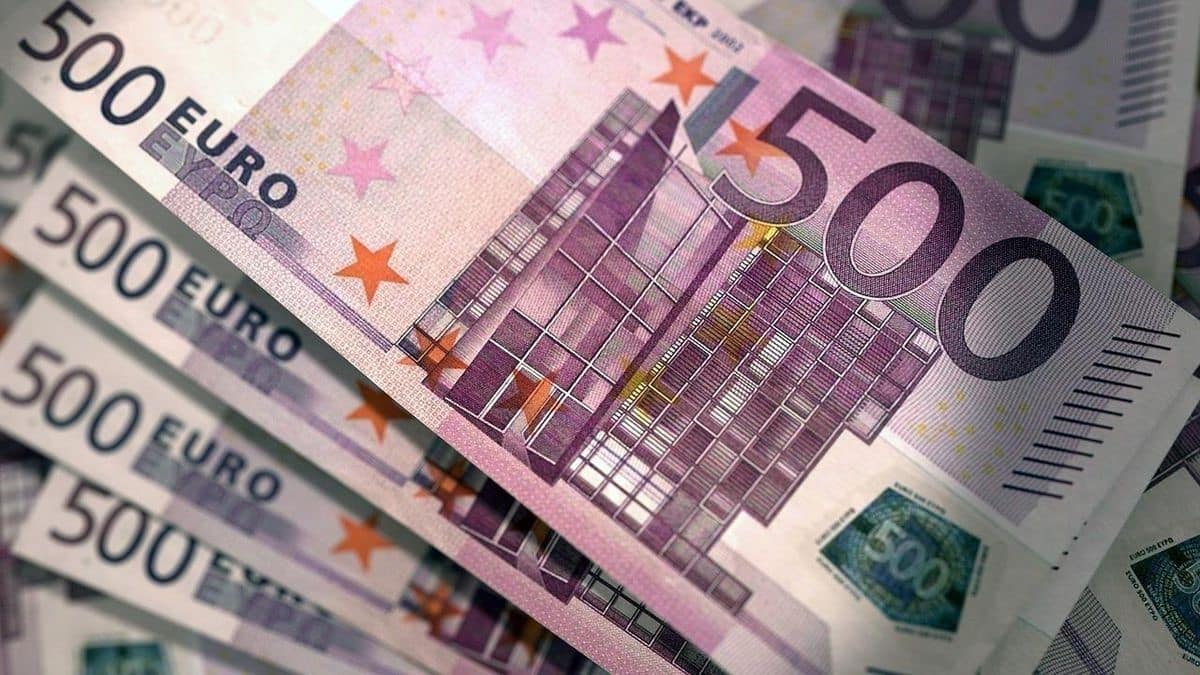
the the largest euro bill is the 500-euro bill. It measures 160 mm x 82 mm, making it the largest bill in the entire eurozone. The rule is simple: the higher the face value, the longer the bill.
The European Central Bank (ECB) stopped issuing this denomination in early 2019 (the last bills were actually printed as early as 2014). However, it remains valid and is still legal tender. legal everywhere in Europe.
What are all the denominations of euro banknotes?
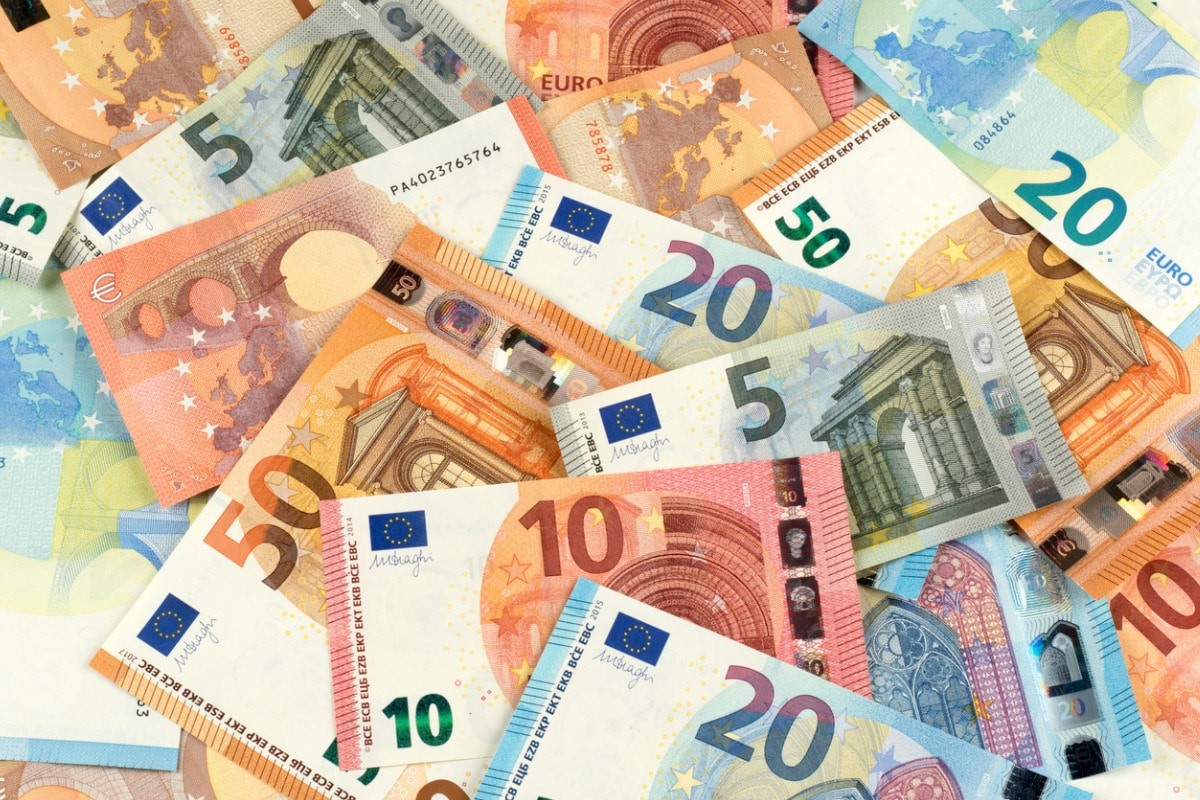
It exists 7 cuts of euro banknotes, each with a distinct color and size. The higher the denomination, the larger the bill. Here is the complete list of bills currently in circulation:
| Ticket (euro) | Color | Format (in mm) | architectural style |
|---|---|---|---|
| 5 euros | Grey | 120x62 | Classic |
| 10 euros | Red | 127x67 | Novel |
| 20 euros | Blue | 133x72 | Gothic |
| 50 euros | Orange | 140x77 | Renaissance |
| 100 euros | Green | 147x82 | Baroque and Rococo |
| 200 euros | Yellow-brown | 153x82 | Industrial Style (19th century) |
| 500 euros | Purple | 160x82 | Modern Architecture (20th Century) |
These dimensions correspond to the first series. In the Europa series, the 100- and 200-euro notes were made slightly shorter (147 x 77 mm and 153 x 77 mm) to match the 50-euro note.
The colors allow us to distinguish between the cuts At a glance. The 500-euro bill can be recognized, in particular, by its purple characteristic.
What characterize the euro banknotes?
The euro banknotes have legal tender throughout the eurozone. They were designed by Robert Kalina, from the Austrian central bank (Oesterreichische Nationalbank) in Austria, and were put into circulation in January 2002.
The euro banknotes were issued in two series separate series. The first series was introduced in 2002. The second series, known as the Europa series, gradually replaced the first starting in 2013.
The Europa series features enhanced security features on every denomination. Both series remain valid and accepted throughout the’European Union.
The issuance of tickets is coordinated by the European Central Bank (ECB) and carried out by the national central banks of each member country.
In France, the Banque de France is responsible for putting banknotes into circulation. In Germany, this task falls to the Deutsche Bundesbank. Each national central bank contributes to the printing and distribution of banknotes in its country.
Every bill has the same symbols. On the front, you'll see windows and gates, which evoke the spirit of openness of the’European Union, as well as the twelve stars symbolizing European harmony. On the reverse side, bridges symbolize the connection between the peoples of Europe and the rest of the world.
All the tickets display the name of the currency in two alphabets: EURO in Latin characters and ΕΥΡΩ in Greek characters. It also includes variations of the ECB's initials (BCE, ECB, EZB, EKT and EKP), the ECB President’s signature, and the flag of the European Union.
Is the 500-euro bill still in circulation?
Yes, you can still use it. The 500-euro bill remains legal tender: it retains its value and continues to be accepted as cash payment throughout the eurozone. Here are the key dates to keep in mind:
- In May 2016, the European Central Bank announced its decision to end this restriction. The reason given: the use of this banknote in high-value anonymous transactions linked to illicit activities such as money laundering.
- From the January 27, 2019, 17 of the 19 national central banks in the eurozone have stopped issuing these banknotes. To ensure a smooth transition, the Deutsche Bundesbank in Germany and the’Oesterreichische Nationalbank In Austria, they continued to distribute them through April 26, 2019.
You can find more details in the European Central Bank's official press release: https://www.ecb.europa.eu/press/pr/date/2016/html/pr160504.fr.html
In practical terms, these tickets are becoming increasingly rare at ATMs. You can deposit them into your account or exchange them at your bank.
In France, you can turn them in directly to the Banque de France, which removes them from circulation without invalidating them. Since its issuance was discontinued in 2019, the 200-euro bill is already the highest denomination still in circulation in Europe. As for the 500-euro note, it is now only in circulation from existing stock, which is dwindling each month.
It should be noted that similar questions arise regarding other means of payment, such as the 10-euro coin, whose legal status is often poorly understood.
Where can you still find and use the 500-euro bill?
the 500-euro bill remains legal tender in all eurozone countries. However, some businesses and individuals may refuse to accept it in practice, particularly because of the difficulty of giving change. There is no law requiring a merchant to accept a high-denomination bill.
If you have one, here are your options:
- Put it on your account banking.
- the remove in exchanging in exchange for cuts smaller value at your bank.
- Report it to the Banque de France if you are French, or at the national central bank of your country.
In Germany, the Deutsche Bundesbank also provides this exchange service for individuals. The number of 500-euro bills still in circulation is decreasing each month as central banks withdraw them from circulation.
Cash Payment Limit: What the Law Says
Individuals who are tax residents of France may pay up to 1,000 euros in cash from a professional. This limit increases to 15,000 euros For individuals whose tax residence is abroad (such as tourists), this applies only to personal expenses.
Between private individuals, however, there is no legal limit: you can buy a used car with cash from another private individual, regardless of the amount. A written document (certificate or sales contract) is required, however, for amounts over 1,500 euros to prove the transaction.
This ceiling applies in particular to:
- Shopping in trade (stores, shops).
- The payments invoices from a professional.
- High-value transactions, such as buying a vehicle from a dealer.
A merchant has the right to refuse a 500-euro bill if they cannot provide change, and doing so does not constitute an illegal refusal. The Banque de France clarifies that legal tender does not create an absolute obligation to accept any denomination under all circumstances.
How to Tell if a 500-Euro Bill Is Genuine
To check a 500-euro bill, the "feel, look, and tilt" method works for all euro banknotes. For the 500-euro note, refer to the security features of the first series, which is the only one available for this denomination.
These safety signs are easy to spot once you know what to look for.
- To touch : The paper is firm and slightly rough. You can feel a distinctive texture on the numbers and main letters.
- Looking at the Light : You'll see the watermark, the safety wire, the symbol euro and the incomplete number. These are signs that you can't reproduce easily.
- Tilt the bill : The hologram changes and shifts depending on the angle. Note: The 500-euro note exists only in the first series; it was never redesigned for the Europa series. Its watermark features an architectural motif and the number 500, not a portrait of Europa. If someone shows you a 500-euro note with a portrait in the watermark, be wary: it’s a counterfeit.
The European Central Bank (ECB) and the national central banks, including the Banque de France and the Deutsche Bundesbank In Germany, authorities recommend performing this check before accepting a large-denomination bill value in liquid. A post fake will generally not take all three tests at the same time.
What should you do with a damaged euro bill?
A damaged ticket is still eligible for a refund. The European Central Bank has established common rules throughout the eurozone for this type of request.
If your ticket is torn or incomplete, here's what to do:
- Take the ticket back to your bank or directly to the Banque de France.
- If you have more than 50 % of the ticket, you receive its value complete.
- If you're under 50 % For the ticket, you can only get a refund if you can prove that the missing portion was destroyed (for example, in a fire or an accident).
This rule applies to all cuts, of 5-euro bill to 500-euro bill. There Banque de France processes these requests free of charge for individuals. You can also find more information directly on the Banque de France website: https://www.banque-france.fr to see the exact steps to follow.
Statistics: How many 500-euro bills are still in circulation?
As of early 2025, approximately 235 million 500-euro banknotes were still in circulation in the eurozone, with a total value of about 118 billion euros. By way of comparison, there were still 521 million of them in early 2019, when issuance ceased, and the all-time high was reached in late 2015 with more than 613 million notes.
To learn more about the different euro banknotes in circulation, check out our Full article on euro banknotes.
For other practical questions about the parts and tickets, see also our article on the CFA franc or on the 10-euro coin.








 English