Chrome blocks the pop-ups by default, but you can change this behavior with just a few clicks.
These pop-up windows are sometimes harmless, but some of them hide phishing attacks.
How do I block or allow pop-ups in Chrome?
When a website tries to display a pop-up, a An icon appears to the right of the address bar to let you know. You can then allow or block the pop-up as you wish.
If pop-ups continue to appear even after they've been blocked, this is often a sign of a malicious software installed on your computer. In that case, take control of the settings yourself.
Block all pop-ups in Chrome
To block pop-ups To do this on a computer, follow these steps:
- Open Chrome on your computer.
- Click on the three points at top right.
- Select Settings.
- Go to Privacy and securitythen to Site parameters.
- Go down to Pop-ups and Redirects.

- Choose Do not allow websites to display pop-ups or use redirects.
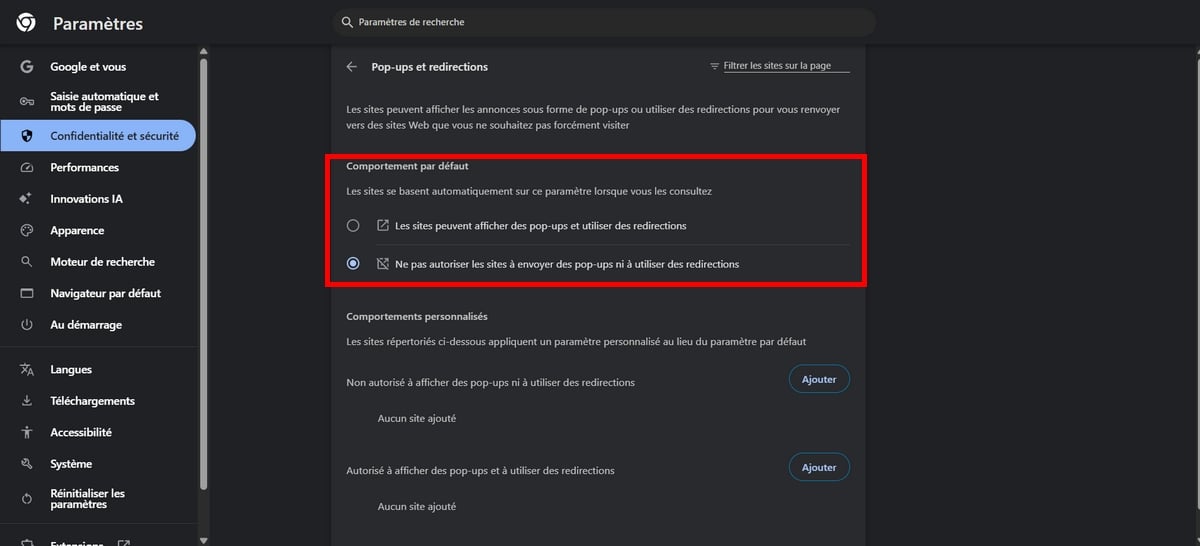
This is the enabled option by default. To do the opposite and allow pop-ups everywhere, select the other option from that same menu.
Allow or block pop-ups on a specific website
You can control the behavior site by site, without allowing everything. There are two methods.
The fastest way: Open the relevant page, click on the’icon to the left of the address (the settings icon), then tap Site Settings. Then adjust the line Pop-ups and Redirects on "Allow" or "Block.".
Otherwise, go to Settings: in Privacy and security, go to Site parameters, then Pop-ups and Redirects. At the bottom, next to Allowed to display pop-ups Where Not allowed, click on Add.
Enter the website address (for example exemple.com) and valid.
A pop-up isn't always an ad. Some websites use them to display useful content. If a feature stops working, consider allow pop-ups for this specific site. You can also check your download notifications if certain elements seem to be stuck for no apparent reason.
Block Pop-ups on Android
On Android, open Chrome and tap the three dots in the upper-right corner. Select Settings, then go to Site parameters. Press Pop-ups and Redirects and turns off the option.
Chrome blocks pop-ups on all the websites you visit on your phone. You can also manage the notifications by site from that same menu, to avoid unwanted requests.
Block Pop-ups on iPhone and iPad
On iPhone and iPad, open Chrome and tap the three dots in the lower-right corner. Select Settings, then go to Content Settings. Press Block pop-ups and enable the option.
The notifications Chrome on iOS can be managed directly from your iPhone's settings, in the section dedicated to Chrome.
What browser extensions are available for blocking ads?
The native blocking of Chrome already handles pop-ups and redirects. But if you want to take it a step further and block ads on the websites you visit, an extension of the Chrome Web Store gets the job done.
Watch out for a common pitfall: uBlock Origin and AdBlock Plus are two very distinct extensions, with different editors. Here are the main ones, along with their strengths.
uBlock Origin
It's one of the most lightweight and effective at the moment. She is free and open source, developed by Raymond Hill. Click on its icon in the toolbar to block pop-ups and site-specific ads.
It also applies content filters and blocks certain types of malware. It uses very few resources on your computer, making it a good default choice.
AdBlock Plus
Not to be confused with the previous one. AdBlock Plus is published by the company eyeo and remains one of the most downloaded, with hundreds of millions of users. It blocks most ads on any website, and you can turn the ad blocker on or off with a single click.
Note: his program “Acceptable Ads” allows certain ads that are considered non-intrusive to appear. You can turn this off in the settings if you prefer to block all ads.
AdGuard AdBlocker
AdGuard is designed for a more comprehensive user experience. It blocks pop-ups, traditional ads, and even those from social networks. She also adds a layer of phishing protection and websites that host malware, which helps protect your privacy while you browse.
Ads Killer
Ads Killer removes banners, pop-ups, rich media content, and tracking systems. With just one click, it blocks ads on the websites you visit. Its main advantage: it prevents companies from tracking you as you move from one website to another.








 English