To add a Audio Fade in Premiere Pro, open the panel Effects via Window > Effects and uses the audio transitions built-in. Would you prefer more precise control? The technique using key images lets you draw the volume curve exactly the way you want.
Explanatory video in French by Alucare, ideal complement to the page. View video (you can use YouTube's automatic translation)

How to Add an Audio Fade to Premiere Pro ?
The fastest way to a video editing cleanup involves the audio transitions included in Adobe Premiere Pro. Here are the illustrated steps to follow.
- Open Adobe Premiere Pro and upload your project.
- Import a audio file or one audio clip on the timeline : This is the clip that will be faded in.
- Go to Window > Effects to open the effects ofAdobe Premiere.

- Unroll Audio Transitions > Crossfade in the Effects panel.
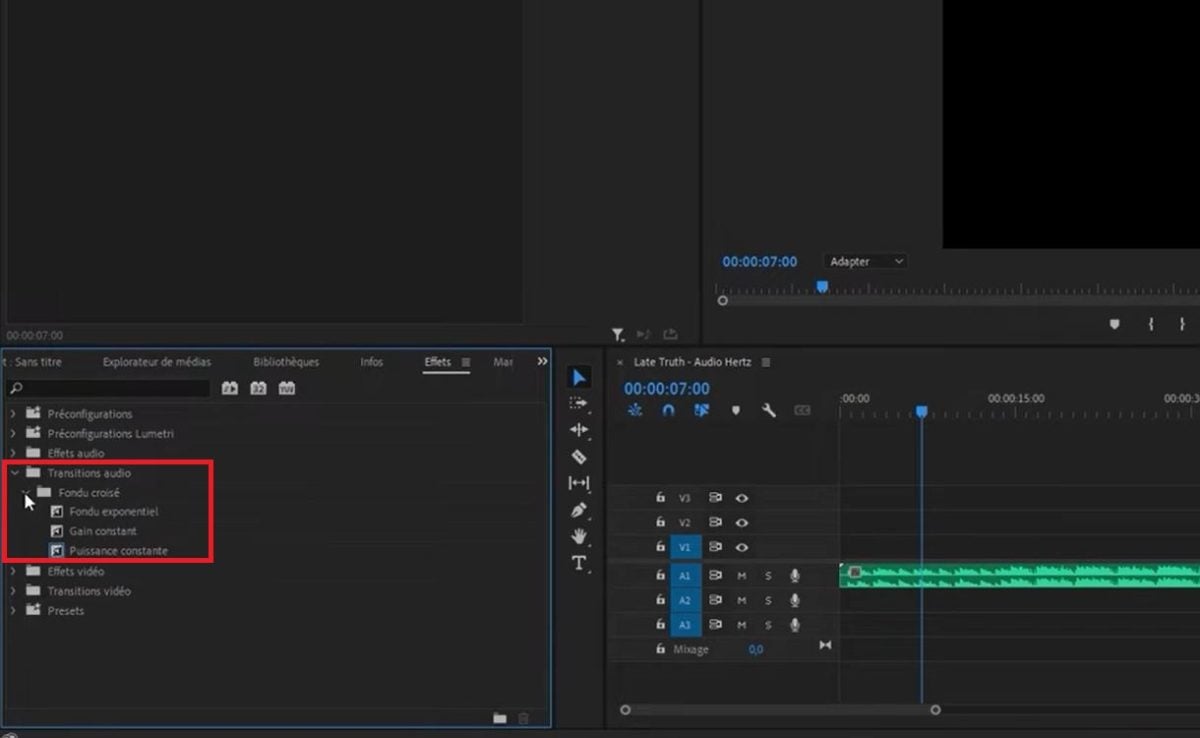
- Select the type of transition, then drag the effect at the beginning Where at the end from your music video onto the audio track.
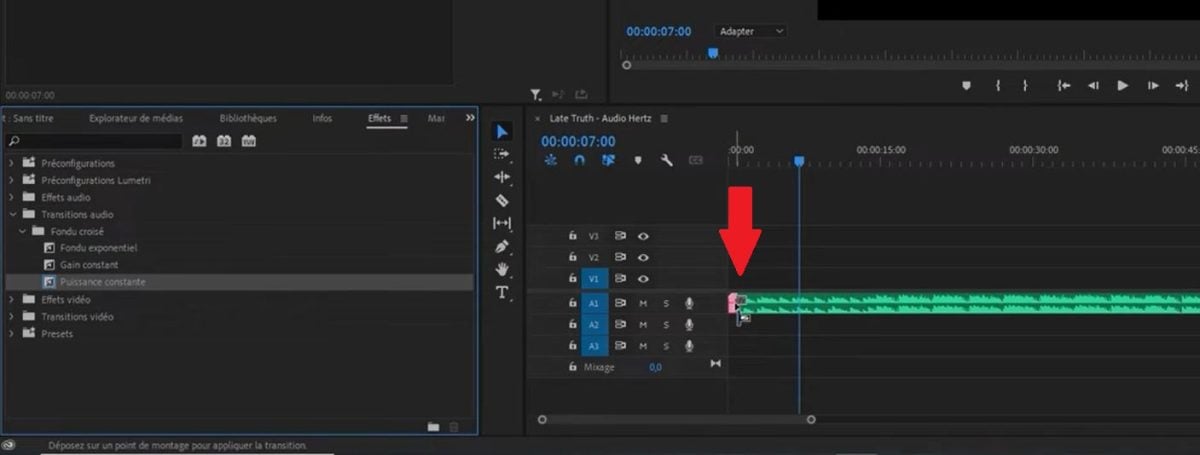
Perspective changes everything. In start of the trail, you get a fade-in : The volume gradually increases. In end of the track, it's a fade-out : The volume gradually fades to silence.
To adjust the duration, click on the transition you've added, then extend or shorten it directly in the timeline. A short fade works well for voice-overs; a longer fade is better suited for background music.
Choosing the Right Type of Audio Fade on Adobe Premiere Pro
The menu Crossfade offers three audio transitions, each of which gives your video clips a different look:
- Constant power : the most natural-sounding transition, ideal for linking two audio clips.
- Constant gain : The volume changes linearly, which is useful for a more mechanical effect.
- Exponential gain : perfect for applying a fade-out clean at the end of the sequence.
A little detail to keep in mind: crossfading is primarily designed for the connection between two clips. On a single clip, hold Ctrl while dragging and dropping to position the transition exactly at the beginning or end. If you're also working on the image and want to add a logo to your video, Premiere Pro offers a dedicated option for that.
The keyframe method (more precise)
Do you want complete control over your audio fade in Adobe Premiere Pro ? Visit key images allow you to precisely define where and how the volume changes on each track. This is editors’ go-to technique for a truly customized result.
- Make a Right-click on the audio clip in the timeline.
- Choose Display audio keyframes, then Volume.
- A horizontal line appears in the clip: it's the volume curve.
- Click on this line to ask a question two points at the beginning (or end) of the video.
- Drag the first point downward to create the fade manually.
You adjust the curve point by point. This is ideal when a simple crossfade isn't enough for your audio elements.
Fixing a problematic audio crossfade in Premiere Pro
A audio crossfade Stuttering or sudden cuts are almost always caused by the same factors:
- Not enough material (handles) on each side of the cut: extend your clips before applying the transition.
- The background is placed on the wrong lead : Make sure you're working on the correct audio track.
- A white remains audible: move the two clips closer together so they overlap slightly.
Now you know how to add a audio fade to Premiere Pro, both when entering and exiting, using transitions or keyframes.
Check out:








 English