Your PC is suddenly very slow, your battery empties unusually quickly, your browser redirects you to unknown sites or your connection sends data for no apparent reason?
If you're wondering « how do I know if my computer is being spied on?», These signs should alert you to the possibility of suspicious activity in the background, and the need to learn how to detect spyware.
👏 Good news: we can confirm it by 2 minutes via the task manager and, above all, remove it for good with a dedicated antivirus scan.
Discover in this article the free methods and if they're not enough, the solution that works in 95% of cases.
Some signs that your computer is being monitored

Here are a few signs that may indicate you're being spied on through your computer.
Please note that these indications are not necessarily absolute proof. Sometimes, they just indicate a technical problem or a setting at day system.
1. A light that turns on by itself
The light from your webcam turns on by itself, without you turning on the camera or without a dedicated app using it?
It is highly likely that a software program activate your camera without your knowledge.
If you see your webcam's LED light up without having launched a video app, that's a serious sign: on most PCs, this LED is hardwired to the camera's power supply, so it clearly indicates that the camera is actually active.
To check which application is involved :
- See you in the Windows privacy settings then Privacy and Camera.
2. A sudden drop in performance
If your machine becomes extremely slow When running programs, if your processor—which usually runs quickly—is running slowly, it may be because malware is running in the background and slowing down every process.
Likewise, if the battery discharges more quickly than usual, this is another sign that monitoring software is running on the computer.
3. Strange browser behavior
- You are redirected to websites other than those you've selected?
- The new unexpected toolbars appear in your browser?
In this case, be careful, because you may have a installed malware on your computer that is trying to take control of it.
What's more, if certain keys are not operational in your web browser, or if they don't work when you select the next field in a form, this may indicate that a malicious script interferes with it.
4. Many pop-up windows
Similarly, if you are confronted with a numerous pop-up windows, this is sometimes a sign of espionage.
Spyware is often accompanied by advertising software (adwares).
5. Unusual network activities
If your computer also has a unusual network activity, like large downloads data, it's quite possible that you're being spied on through it.
In fact, these programs may be using your Internet connection to’send data from your computer to a remote server without your knowledge.
6. Strange computer programs or processes
If you notice any unknown computer processes Since this is happening on your computer, it's possible that someone is monitoring your every move.
It could be a toolbar, unusual software or an unknown program.
What are some ways to find out if someone is spying on me through my computer?

Here are a few reliable techniques to find out what kind of monitoring program has made its way into your home, and how limit access the websites you visit:
Here are a few techniques for unmasking a surveillance application:
1. Check task manager
There are a myriad of devices and programs that can be downloaded to track your activities.
They can be added to your PC without you even knowing it.
To check them manually :
- On Windows: Open the Task manager by clicking on Ctrl + Shift + Escape
- On Mac: Press the [CMD]. + [option] + [Escape] (Mac) to force quit. But to see all processes, open Spotlight (Cmd + Space), then type «Activity Monitor»
- You can also search for Task manager next to the To start up on Windows
- Under the Process in the background, you'll see a complete list of the applications running on your PC
- Browse through the list. If an app seems suspicious, feel free to do some research to find out more.
❌ Limits :
Remember that in most cases, spyware rarely wear their real name in the process list.
They often use identical system headings to those of legitimate Windows files, making it particularly difficult to identify them or verify their true nature.
In addition, other malware programs are being developed to close as soon as we open the Task Manager to remain undetected.
2. Check user accounts
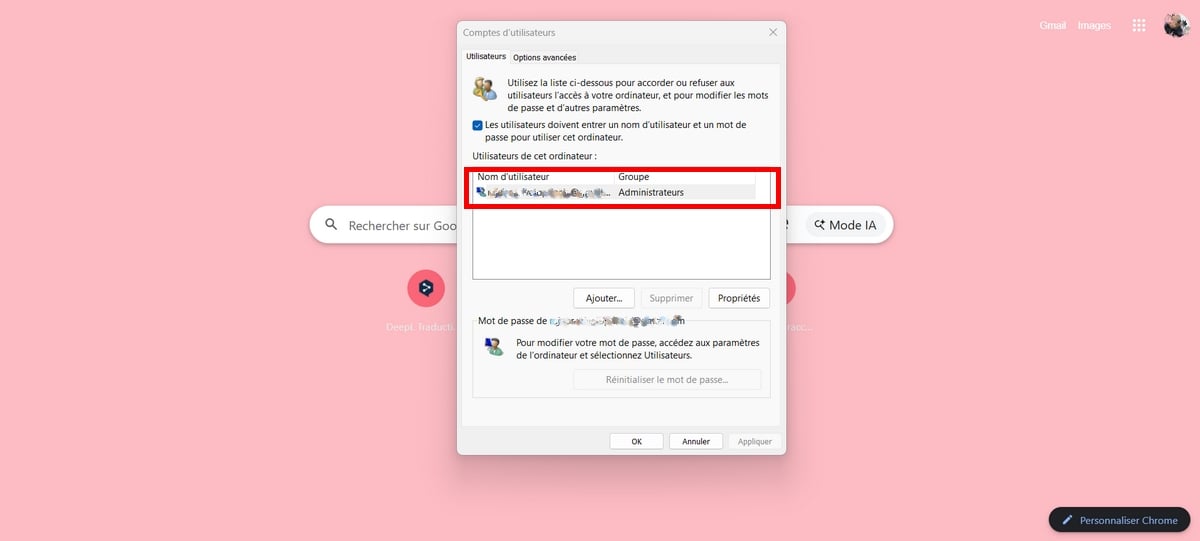
If you think your computer is being monitored, you can also check the local user accounts on this one.
On Windows :
- Click on Win + R simultaneously
- Then type netplwiz
- Finally, press Entrance
On Mac :
- Click the Apple icon on the left side of the screen
- Then click on System Preferences
- You'll find « Users and groups“.
- Normally, you will find all active accounts on your computer
- If you find a administrator account, other than your own, that you did not create yourself or that is not linked to the main account, click on it and delete-the.
❌ Limits :
A spy They don't always need to create a user account to spy on what you're doing. Sometimes, they can just install a hidden script on your user account.
As a result, you will find nothing while browsing the list, even though malware is actively running in the background during your session.
You've seen the limits of the manual methods :
- Recent stalkerwares even have false system names
- They close as soon as you open the Task Manager.
- In addition, they don't need to create an account to use it.
Fortunately, that is exactly what specialized antivirus programs detect—through behavioral analysis, not by file name.
3. Use antivirus software
The most fast and secure to check whether you have spyware installed on your computer without your knowledge is to call a antivirus service.
Highly appreciated for its comprehensive and reliable features, Bitdefender allows you to :
- ✅ Detecting invisible threats (stalkerwares) on your machine
- ✅ Benefit a protection in real time with a advanced firewall which monitors outgoing network connections
- ✅ Strengthen your privacy day-to-day
- ✅ Delete entirely spyware once you've installed it and started the scan
You can download it in just a few minutes from the official website. Here's how it works:
- Visit the official website:
- Choose the subscription plan that's right for you, or sign up for the 30-day free trial
- Then click on the Download free antivirus software.
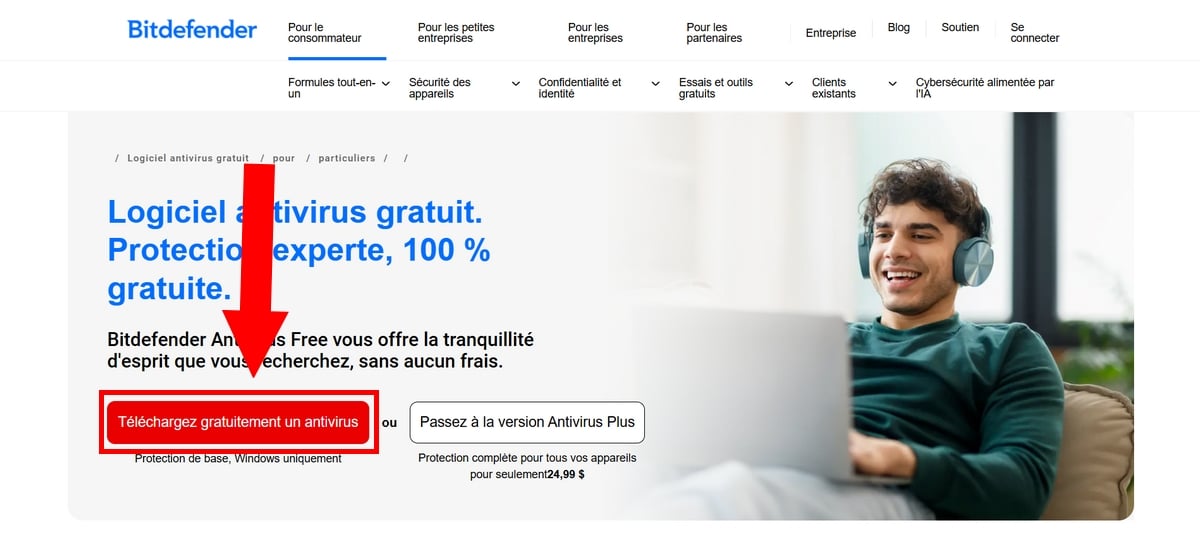
- Then click on thedownload history in your browser to start the installation of Bitdefender on your device.
- Then, please wait and follow the instructions on your screen to complete the process.
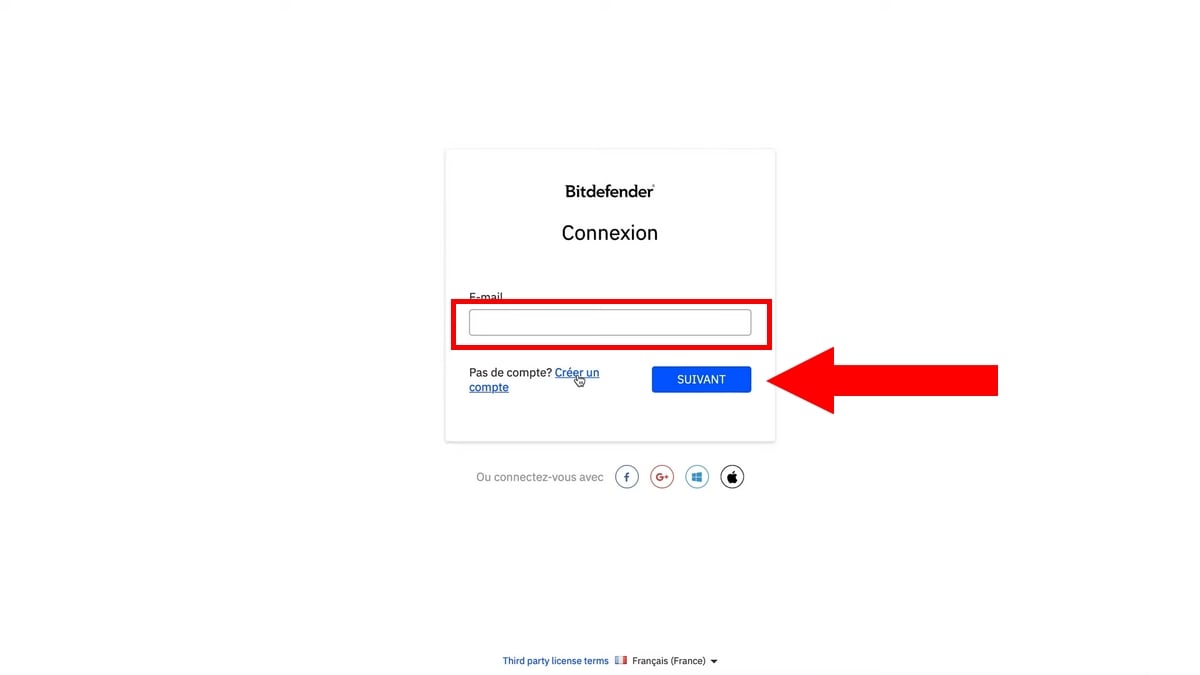
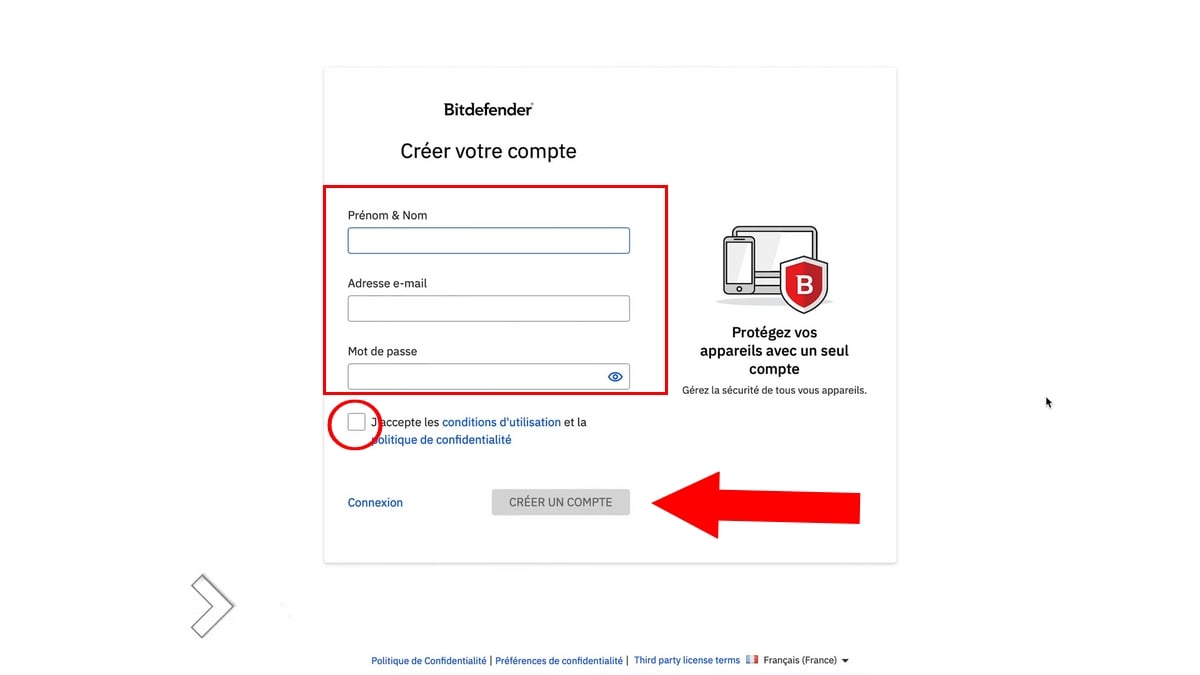
- If you don't have an account yet, we've reached the step where you need to create one.
- Enter your name, e-mail address and password (as requested by the software). Then click on Create an account.
- Then we reach the stage where Bitdefender detects threats and gets rid of malware that may be present on your computer
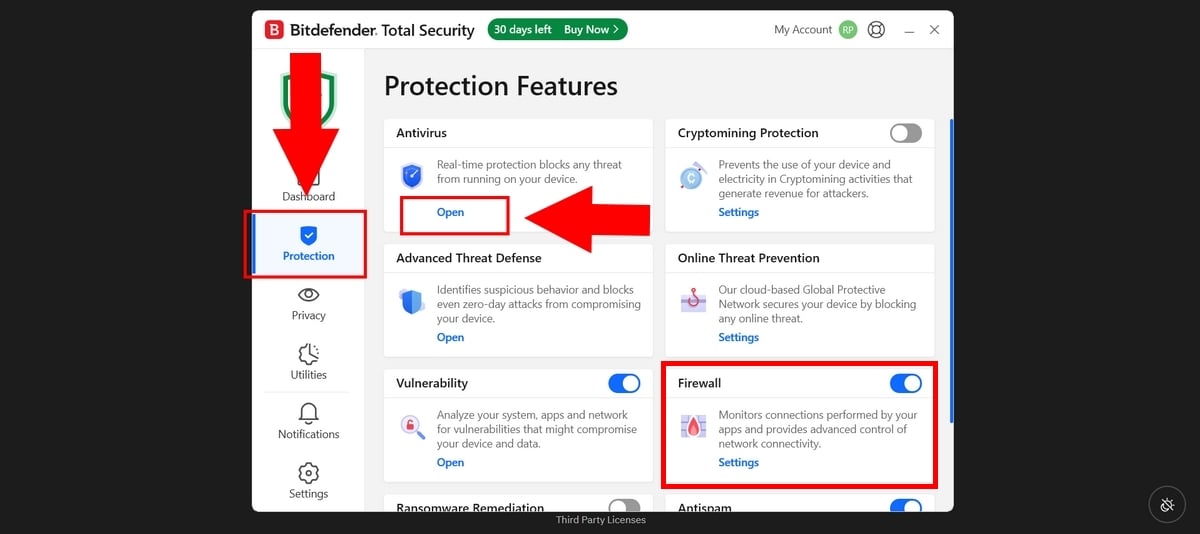
- Once you've logged in, you'll come to this menu. Click on Protection, activate the firewall to prevent suspicious applications from sending your data over the Internet.
- Also go to Antivirus, click on Open Where Open
- Look for the option Scan System and then click on Start scan Where Run Scan
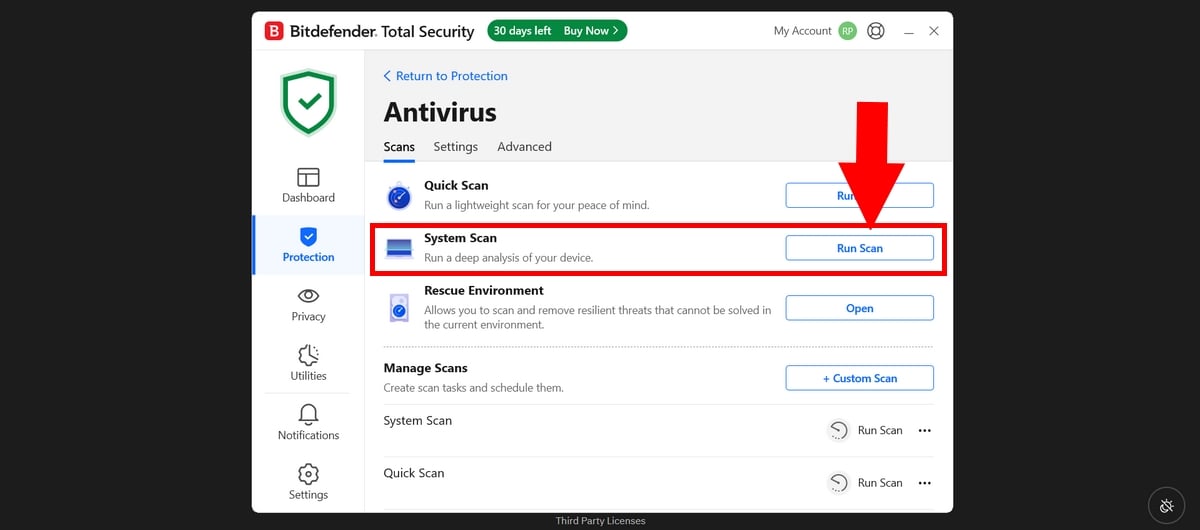
- The scan will then begin, and you'll need to wait while it analyzes all the files on your computer.
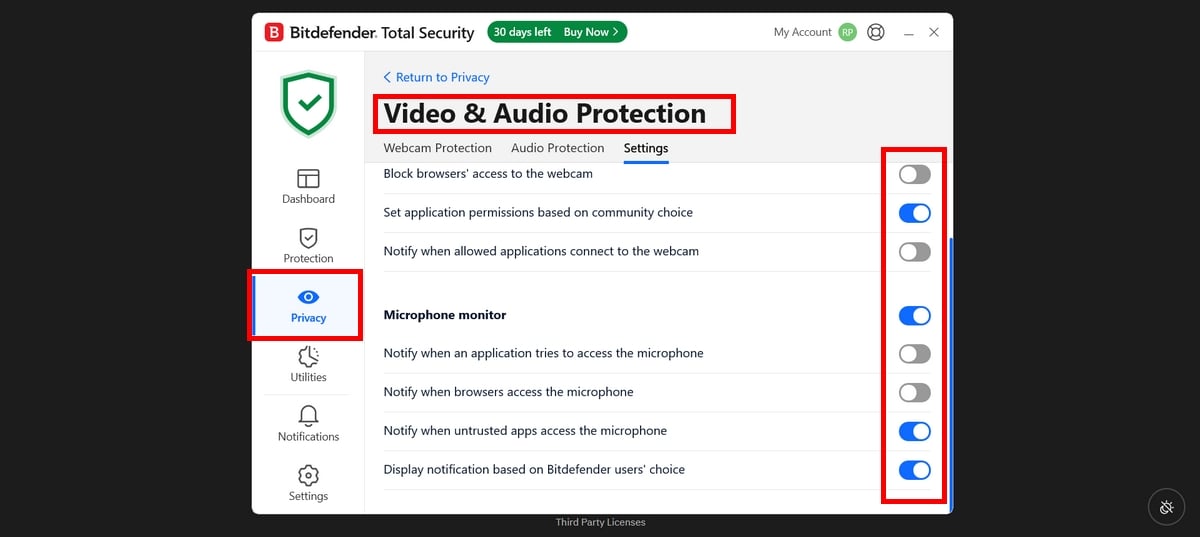
- In the meantime, in the’Privacy tab Where Privacy, you can configure the settings to receive a notification whenever an app or other software attempts to access your camera and microphone.
- Once the scan is complete, if Bitdefender finds something suspicious on your device, it will block it.
- And if he asks you what to do with it, you can choose the option Delete.
To note :
The stages remain the same on MacOS. Please note, however, that the free version offers rather limited functionality.
- If you want premium protection, feel free to try the free version for 30 days for starters.
- However, in the free version, the vpn is limited to 200 MB of data per day. So use it only when necessary—that is, when you're out and about or when shopping online.
Computer surveillance: What can you do?
Find a PC spyware, that's a shock! But before you delete it, take five minutes to think it over. If the person monitoring you is an abusive or potentially dangerous loved one, uninstalling it abruptly will alert them.
Here is the order in which to proceed, from the safest to the most definitive:
- Don't talk an overview of the situation from the compromised device
- Use a other device To be on the safe side, log in to your accounts to change your passwords and enable 2FA
- Go check out the’connection history your Google and Microsoft accounts to detect unknown downloads or sessions
- If you have evidence To prevent spying, take screenshots from another device
- Depending on the context, call 3919 if you are facing domestic violence, the CNIL if your employer is monitoring you without your knowledge
- Once you've taken all the necessary steps, think about the cleaning the device.
How can I protect my computer from being spied on?
Here are a few precautions to be taken to protect you from malware in the future.
1. Install an anti-virus security program
Install anti-spyware software and make sure they are updated automatically and frequently. After all, new and potentially dangerous viruses appear every day.
Among the best solutions, Bitdefender is a powerful solution for detect invisible threats, to block suspicious outgoing connections, but also to delete them malware on your computer easily, even if they use fake names.
To protect your device and install a powerful antivirus :
I trust Bitdefender to protect my computer
2. Prefer official stores for applications
To avoid unintentionally installing spyware on your computer, it's important not to click on attachments or emails from unknown sources.
It is also important to give priority to official stores to download games or other apps.
3. Buy a brand new computer
If you can afford a new computer, that's one of the best ways to avoid hacking.
If you choose this option, do not move any files (documents, images, videos, etc.) from the infected computer to this new computer because spyware could relocate on the new system.
4. Keep your device up to date
Often pirates They exploit security vulnerabilities on your device to gain easy access to it. To prevent this, be sure to install Windows or macOS updates.
5. Create new accounts and update your passwords
If you're worried about surveillance, change your passwords from another secure device.
And most importantly, never use the same ones passwords for all your accounts.
FAQs
How do I know if I'm being spied on?
There is no specific code that can tell you whether or not your device is being spied on. The safest way is to use a antivirus software performing.
What is the best free antivirus program for detecting spyware?
There are numerous free antivirus programs on the market. Be careful, however, as some malware masquerading as free antivirus software.
If you want comprehensive protection, you can try the’Bitdefender free trial for 30 days. Also, please note that it offers a free version for Windows (Bitdefender Antivirus Free).
However, for a in-depth detection If there is malware on your computer, it is recommended that you choose the full version.
To test BitDefender for free for 30 days :
Using Bitdefender to detect spying on my PC
Is it normal for my processor to be used at 100% at idle?
Nope, it is not normal for a processor in idle mode to be using 100% when you are not running any programs. In idle mode, the usage should ideally be less than 5% or 10%.
How do I check the login history for my accounts (Google, Microsoft)?
- Go to your Google account ⇒ Security and connection ⇒ go to the Your devices. You'll have access to all the devices that have access to your account.
If you see an unknown device, disconnect it and quickly change your passwords.
Who can see what I'm doing on my PC?
Here is a list of all those who can track your activities on your computer:
- The administrators of public wifi networks
- The Internet service providers (ISP): The sites you visit
- Some websites Via cookies
- The authorities and investigators : On request from your ISP
- The pirates Where spies.
Can my employer monitor me?
Monitoring software can be installed by employers on devices provided by the company, such as laptops.
However, even though your employer has the right to implement monitoring, according to the’article L1222-4 of the Labour Code, it must inform you in advance.
All in all, here are the good reflexes in 3 steps:
- Quickly check via manager of tasks,
- Scan with a antivirus dedicated Bitdefender to confirm,
- Follow the protocol in the previous section before deleting your computer software.








 FR
FR  RU
RU  EN
EN  ES
ES  IT
IT  DE
DE  ZH
ZH  PT
PT  ID
ID  JA
JA  DA
DA
Interesting