ScraperAPI delivers on what matters most: automatic proxy rotation, circumvention of the CAPTCHA and JavaScript rendering. You send a request, you retrieve data from a website, without having to manage the Blocked IPs.
The reviews are mostly positive, with a 4.5/5 rating on Trustpilot and very positive feedback on G2 and Capterra. This web scraping API is suitable for both personal projects and businesses.
The only real downsides are related to the Pricing and the scrapings at very large scale.
Here is a summary of the strengths and weaknesses of ScraperAPI According to user feedback:
| ✅ Highlights | ❌ Weak points |
|---|---|
| Effective CAPTCHA Bypass | Unclear pricing |
| Automatic and efficient management of proxies | Occasional restrictions on throughput and requests |
| Reliable JavaScript rendering | Unsuitable for very large volumes |
| Support for multiple languages (Python, Node.js, PHP, etc.) | Perfectible advanced documentation |
| Easy integration and a simple API |
Global opinion on ScraperAPI
Users summarize ScraperAPI In three words: fast, reliable, effective.
According to the reviews collected on Trustpilot, G2 and Capterra, the average rating is around 4,5/5. These rates change frequently, so be sure to check them when you check in.
| Platform | Score out of 5 |
|---|---|
| Trustpilot | 4,5(based on about 42 reviews) |
| G2 | 4,3/5 |
| Capterra | 4,6/5 (customer service note) |
The strengths most frequently mentioned in reviews:
- Reliable and efficient scraping, even on complex websites.
- Ease of integration : All you need is a single API key to get started.
- Customer support responsive and highly rated.
- Good value for money for regular use.
- Advanced features such as IP rotation and rendering JavaScript.
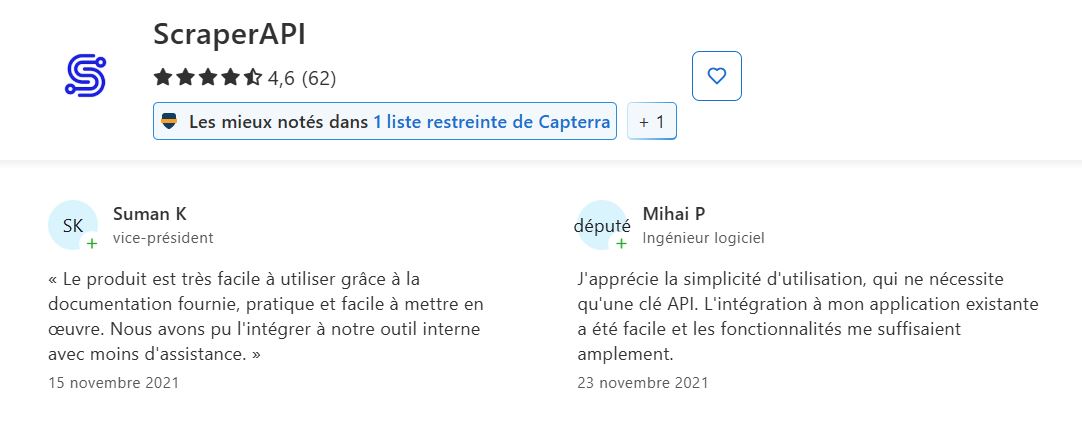
According Suman K and Mihai P on Capterra :
"The product is very easy to use thanks to the documentation provided, practical and easy to implement..."
"I appreciate the ease of use, which only requires an API key. Integration with my existing application was easy, and the functionality was more than enough for me."
Akif confirms on Trustpilot :
"Their customer service is excellent..."

Muhammad H. on G2 emphasizes the time saved when dealing with technical issues:
"It simplifies web scraping by managing proxies, CAPTCHAs and browser rendering, allowing me to focus on data extraction rather than technical issues. The API integrates seamlessly into my existing code, and the speed is impressive, even for large-scale projects."

As for the drawbacks, users mainly point out the following:
- Transparency in Pricing : The credit system, with its multipliers based on the type of request, sometimes leaves people confused.
- Documentation Requires further exploration for the most advanced features.
- A few failed requests or throughput limitations occasional.
- A support deemed inconsistent depending on the circumstances.
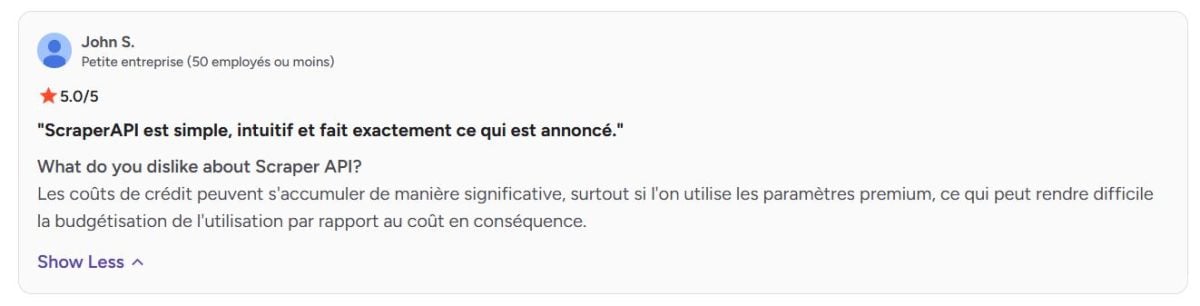
According John S. on G2, the credit balance goes up quickly as soon as you activate the premium options:
"Credit costs can add up significantly, especially if premium parameters are used, which can make it difficult to budget usage versus cost accordingly."
Opinions on ScraperAPI's services
Here are the details of the key services offered by ScraperAPI and what users actually take away from each service, one by one.
1. Automatic rotation of proxies
ScraperAPI is based on a broad proxy pool which it automatically rotates with each query. This IP rotation It greatly reduces slowdowns when you make multiple calls to the same site in quick succession.
The Return of Aditya Pratap Singh on Trustpilot :
"ScraperAPI has revolutionized my web scraping projects. I was constantly struggling with CAPTCHA and IP address blocking before I found this service. Now I can concentrate on using the data instead of fighting for it. Proxy rotation is smooth and I appreciate the automatic handling of JavaScript rendering."

2. Bypass protection management
The tool can bypass the anti-bot mechanisms complex systems, firewalls, and CAPTCHA. The result: smoother data extraction, even on highly secure sites such as Google.
According to Arun K., research associate:
"Google has been successful in blocking programmatic requests, even for non-commercial and self-archiving purposes, and ScraperAPI has proved extremely effective in bypassing them. Although routing requests via ScraperAPI is much slower than, say, via a free proxy server."
Please note: This increase in reliability sometimes comes at the cost of a response time longer than a standard proxy.

3. JavaScript rendering
Thanks to a headless browser integrated, ScraperAPI can scrape dynamic websites whose content is loaded via JavaScript. This way, you retrieve the HTML as Actually Displayed, and not just the Raw HTML returned by the server. This is essential for parsing reliable on client-side-generated pages.
The Return of Fazt Tech on Trustpilot :
"ScraperAPI has considerably improved our web scraping processes. The API is easy to integrate and handles most of the heavy lifting, such as IP address rotation and proxy management, saving us valuable time. The automatic management of captchas is a major asset and greatly simplifies our data collection."

4. Query customization
You can customize your queries HTTP by modifying the headings, them Cookies where the user-agent. This helps simulate different behaviors and avoid detection on the strictest sites.
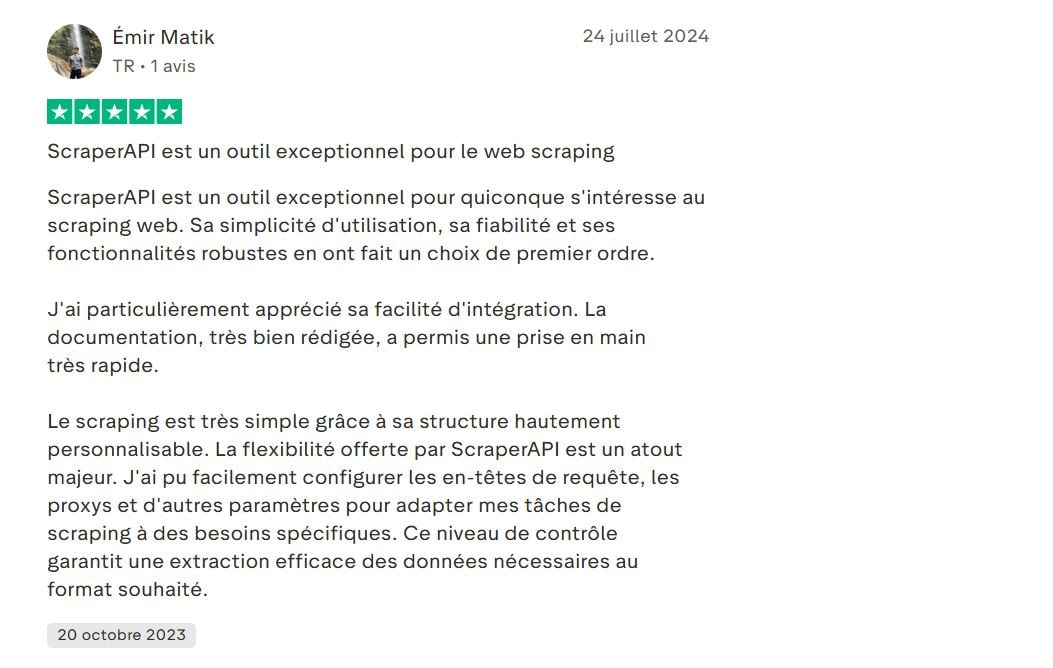
The opinion of Émir Matik on Trustpilot :
«…Scraping is very simple thanks to its highly customizable structure. The flexibility offered by ScraperAPI is a major advantage. I was able to easily configure request headers, proxies, and other settings to tailor my scraping tasks to specific needs…»
5. Proxy geolocation
ScraperAPI lets you choose the’geographic location of the proxies, by country. This geotargeting is useful for retrieving location-specific data or testing results specific to a region, such as prices that vary by market.
The Return of Melih Krs on Trustpilot :
«…In addition, its support for JavaScript rendering and IP geolocation has been invaluable…»

6. Dashboard and statistics
A comprehensive dashboard depends on your usage, the number of requests, the success rate and the game's remaining credits. This way, you can keep a close eye on your usage and adjust your plan based on your actual usage.
According Tahmeem S. on G2 :
"The user interface is quite good, the data transfer function is a very handy feature. The dashboard is very handy to give an overview of the process. I use this tool for web scraping because it helps me get the content of the web pages I use for my research."

7. Integration and multi-language support
ScraperAPI offers a REST API Simple and easy to integrate with most programming languages: Python, Node.js, PHP, Java, etc. This rapid integration makes it easy to adopt in a variety of environments, from small scripts to production projects.
What it says Deni H. on G2 :
«The ideal candidate for the Scraper API position is likely an experienced web scraping developer with knowledge of various scraping technologies, including Python (BeautifulSoup and Selenium), JavaScript (Puppeteer or Cheerio), and Node.js (Demand and Cheerio)…»

8. Advanced data features
Beyond traditional scraping, ScraperAPI takes data processing and large-scale automation a step further:
- Asynchronous scraping : You send millions of requests in parallel, which is ideal for very large-scale data collection across numerous websites.
- Structured Data Endpoints : For some popular sites, the data is returned directly in the format JSON, ready to use without any additional parsing steps. This is particularly useful for hobby projects as well as for startup teams that want to move quickly.
ScraperAPI: Alternatives
ScraperAPI is not the only player in the web scraping. Several alternatives stand out for their approach, pricing, or features. Here are the main ones you should know about before choosing your tool.
| Tool | Special features | User reviews | Average rating |
|---|---|---|---|
| ScraperAPI | Automatic rotation of proxies, JavaScript rendering, customization | Reliable and easy to use, but pricing can be confusing | 4,5 |
| Bright Data | A very comprehensive platform, featuring premium proxies and an advanced data pipeline | Extremely powerful and flexible, but complex to handle | 4,6 |
| ScrapingBee | Simple API with JS rendering and proxy rotation | Easy to integrate and good value for money, but fewer advanced options | 4,9 |
| Octoparse | Code-free visual scraping, programming-free approach | Ideal for non-technical users, but limited when dealing with large volumes | 4,4 |
| Apify | Custom scrapers development platform | Very flexible and customizable, but requires technical skills | 4,8 |
In practical terms, each solution is designed for a different type of user. ScrapingBee remains the closest competitor to ScraperAPI for small and medium-sized loads. Octoparse is aimed at non-developers who want to extract data without writing a single line of code. Apify, on the other hand, is intended for technical teams that build their own scrapers.
If you have very large-scale needs, with a premium proxy pool and a push-based data pipeline, Bright Data is worth a visit.
It's the most powerful solution on the market, but also the most expensive and the one that takes the longest to master. For most use cases, ScraperAPI offers excellent value for the money.
Niklas sums up this position well in Capterra :
«Bright Data is a more expensive service, but it's the best in its class.»

FAQs
Is ScraperAPI free?
No, ScraperAPI is a paid service, but he's still making an offer free of charge limited, with a small number of requests to test the service before choosing a plan.
How much does ScraperAPI cost?
Rates start at 49$/month (Hobby) and go up to 1 975$/month, with an Enterprise plan available upon request for very large volumes. The price depends on the plan selected, the query volume and enabled features such as JavaScript rendering or geotargeting. There are plans suited to both hobby projects and growing startups.
Each request consumes a certain number of variable credits. A simple page in HTML Raw requests cost very little, whereas a request using a premium proxy or JavaScript rendering consumes significantly more.
That's why a plan's credits run out quickly when you scrape complex websites.
How does ScraperAPI work?
ScraperAPI acts as a intermediate between your application and the websites to be scraped. It automatically handles the proxy rotation, IP management, JavaScript rendering, and bypassing security measures.
In practical terms, you send a request to the API and retrieve the content HTML of the target page, without worrying about blockers. The tool relies on a wide a pool of proxies located in many countries to retrieve the data without any interruptions.
How do I use ScraperAPI with Python?
Integration with Python is simple thanks to a Well-documented REST API. All you have to do is send an HTTP request to the API's address with your API key and the target URL.
1. Set the ScraperAPI URL using your API key and the target URL
import requests

url = "http://api.scraperapi.com"
params = {
    'api_key': 'YOUR_API_KEY',
    'url': 'https://exemple.com'
}
2. Send the request
response = requests.get(url, params=params)3. Displays the content of the retrieved page
print(response.text)You can then do some HTML parsing with a library like BeautifulSoup, or directly utilize the structured data endpoints, which return the data in JSON ready to use.
Can ScraperAPI bypass CAPTCHA?
Yes. One of the strengths of ScraperAPI is its ability to automatically bypass the CAPTCHA and other anti-bot systems. That explains its success success rate in many protected areas.
ScraperAPI remains a high-performance solution to automate online data collection. Feel free to ask questions in the comments and share your experience!









 FR
 RU
 EN
 ES
 IT
 DE
 ZH
 PT
 ID
 JA
 DA