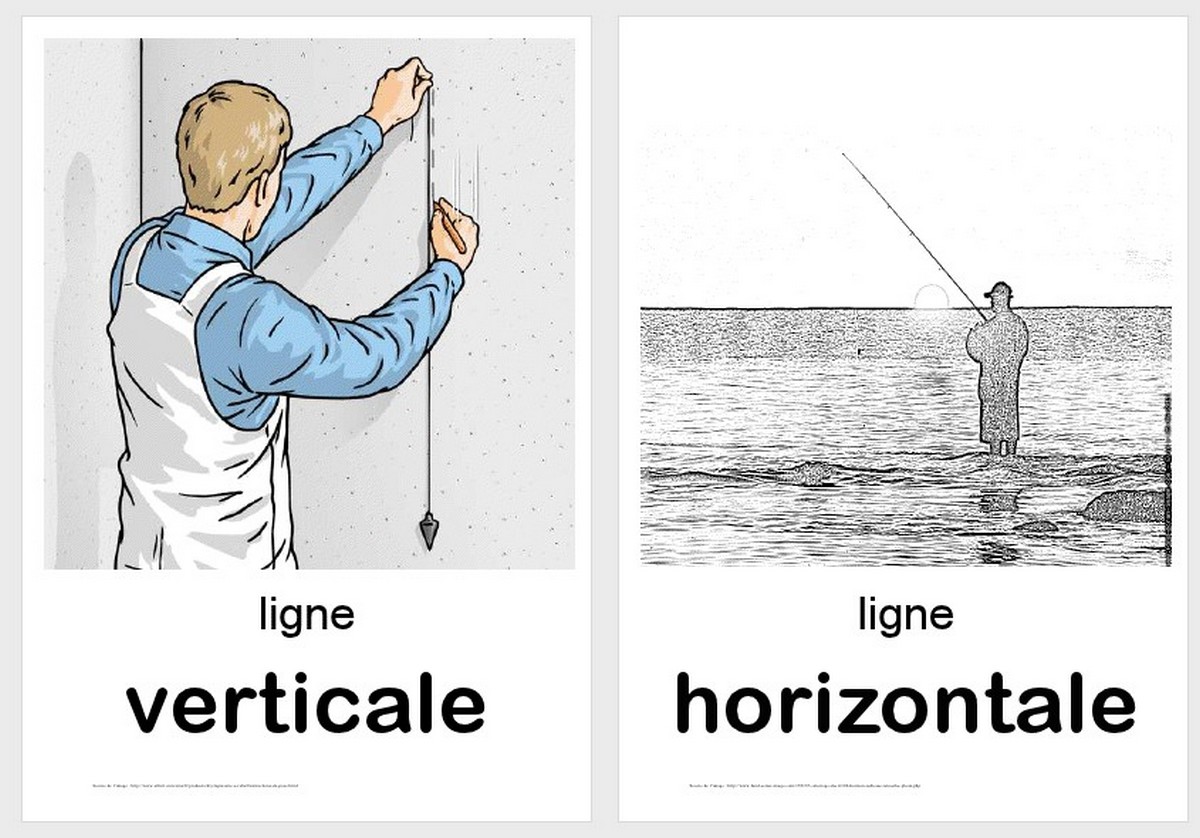
The Horizontal goes from left to right, like the horizon line. The Vertical It stretches from top to bottom, like a straight mast.
Just one tip to remember: horizontal = horizon. If you're still mixing the two up, here are some simple tips to help you never get them wrong again.
What are the horizontal and vertical axes?
The definitions are simple, and once you learn them, you'll never forget them.
- A horizontal line is parallel to the ground. It follows the’horizon, so it goes from left to right.
- A vertical line follows the direction of the gravity. It goes from top to bottom, like a mast.
These two directions are perpendicular : they form a right angle in relation to one another. The horizontal plane is parallel to the ground when at rest. The vertical plane is perpendicular to it.
In geometry, we see the same logic in a coordinate system. The’x-axis (axis X) gives the position horizontal by one point.
L'y-axis (axis Y) states its position vertical. These two axes form a coordinate system used in all charts and data tables.
How do the horizontal and vertical planes affect everyday life?
These two concepts come up constantly in everyday life: to describe a plane, a surface, a position, or even a sports move. The best way to avoid confusing them is to rely on concrete reference points.
The most effective tip can be summed up in one word: the horizon. A horizontal line follows that horizon behind which the sun disappears, completely flat, parallel to the ground. Think of a sunset over the sea. Conversely, a vertical line stands upright, like a mast or a wall.
Two other memory techniques might also help you.
- The word vertical begins with a «v,» which evokes an upright, standing, straight posture.
- L'horizontal brings to mind something that is lying down, stretched out flat.
In mathematics and science
In geometry, the horizontal lines and the game's vertical lines provide the framework for all the reference points and graphs. In a coordinate system, the x-coordinate gives the position horizontal a point; the ordinate is its position vertical. These concepts apply to both statistical data and geometric figures.
In physical, this distinction is just as central. The component horizontal A movement described as moving parallel to the ground.
The component vertical describes motion in the direction of gravity. These concepts are at the heart of mechanics and sciences in general.
These concepts go far beyond math: they are also used in architecture and in the building. The horizontal surfaces (floors, ceilings) and the vertical surfaces (walls, partitions) define any built space.
The easiest way to really remember them is to put them into practice. Look for horizontal and vertical objects around you, or do a few exercises using coordinate planes.
In humans
Your own body provides an excellent point of reference. At birth, a baby spends most of its time lying flat: it is in a position horizontal.
As he develops, he learns to sit and then to stand on both feet, vertical.
Here's a little tip to help you avoid mistakes: in the alphabet, the « h »horizontal« comes before the " v »vertical," just as we first learn to lie down on the ground before standing up. Visualize these concrete examples, and you'll remember the difference for good.








 FR
FR  RU
RU  EN
EN  ES
ES  IT
IT  DE
DE  ZH
ZH  PT
PT  ID
ID  JA
JA  DA
DA