Google Photos can detect the faces on your photos and let them give them a name.
To identify a person, you activate the facial recognition In the settings, then give each group a name.
This feature works on android, iOS and on the web, provided you have a Google account and to be in a country where the position is available.
Identifying a Person in Google Photos: What Are the Steps?
The principle is simple: Google Photos automatically groups similar faces together, and you're the one who identifies who's who. Here's how to do it, on smartphone then on the website.
Enable face detection in Google Photos
Before appointing anyone, you must activate the grouping of similar faces. This option is disabled by default depending on your account and country.
- Open the Google Photos app on your smartphone (android Where iOS).
- Touch your profile photo top right, then go to the Settings then Preferences.

- Go to Group similar faces.
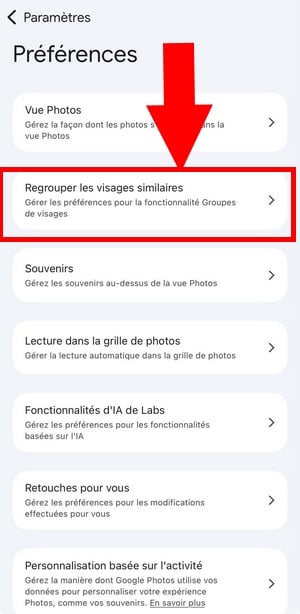
- Active option Face Detection.

To check whether detection is already enabled, go back to that same menu. If the option is enabled, the’algorithm Google already groups your photos by person, and the faces appear sorted in the tab People and Animals.
Name a person on a mobile device (Android and iOS)
Once the group is active, the app organizes the detected faces into a dedicated album. To name it:
- Go to the tab Collections (Where Library (depending on your version), then open People and Animals.
- Tap a group of similar faces that you want to identify.

- At the top of the screen, press the Add a name.

- Enter the name the person's information, then click "Validate.".
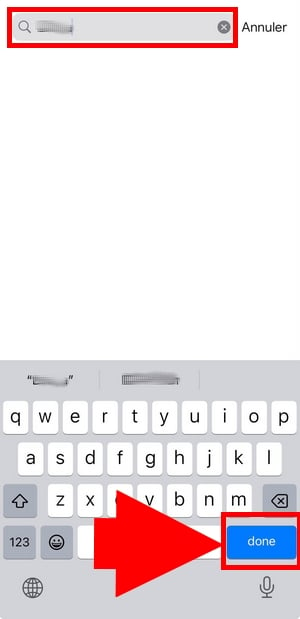
You can also start with a specific photo. Open the image, drag it to the high To view the information, tap the detected face, then enter the name. Google will then apply that label to all photos featuring the same person.
If you're also looking to tag someone on Instagram, the approach is different but just as accessible.
Identify a Face on the Web (photos.google.com)
The same feature has been available for a browser on a PC. You can use it on iOS Where android via the web if you'd rather not use the app.
- Open photos.google.com and sign in to your Google account.
- First, check that Group similar faces is enabled in the Settings.
- Use the search bar or the section People to display the face groups.
- Hover over the group with your mouse, then click on the pencil that appears, then enter the name.
Availability and Limitations of Facial Recognition
The facial recognition Google Photos is based on AI algorithms that analyze facial shape and features. The grouping is semi-automatic : the’AI suggests the groups, but you're the one who confirms each name.
In fact, it can make mistakes when it comes to faces that look very similar.
In order for the face detection For this feature to be triggered, the image must contain at least one human or animal face. A photo of a landscape or a dish will not trigger any grouping.
If you can't find the option Group the faces In your settings, this is probably related to your location.
This feature is restricted or unavailable in several European countries for data protection reasons biometric (RGPD and national laws). In this case, Google disables the feature by default, regardless of your preference. If you're accessing the internet from another country, availability may vary.
What do you need to know about tagging in Google Photos?
Beyond the facial recognition, Google Photos offers other useful tools for managing your photo library. For example, you can sort by size to quickly free up space on your storage device.
It's also interesting to learn about what's known as the’image of a person found online, especially if you're trying to identify someone from a photo you found online. In that case, the Search for images by size Searching on Google can also help you narrow down your results.
Google Photos remains a powerful tool for organizing your memories. The face detection It automates sorting, and the names you assign manually make searching even faster.
Just make sure the feature is available in your country before you get started.







 English