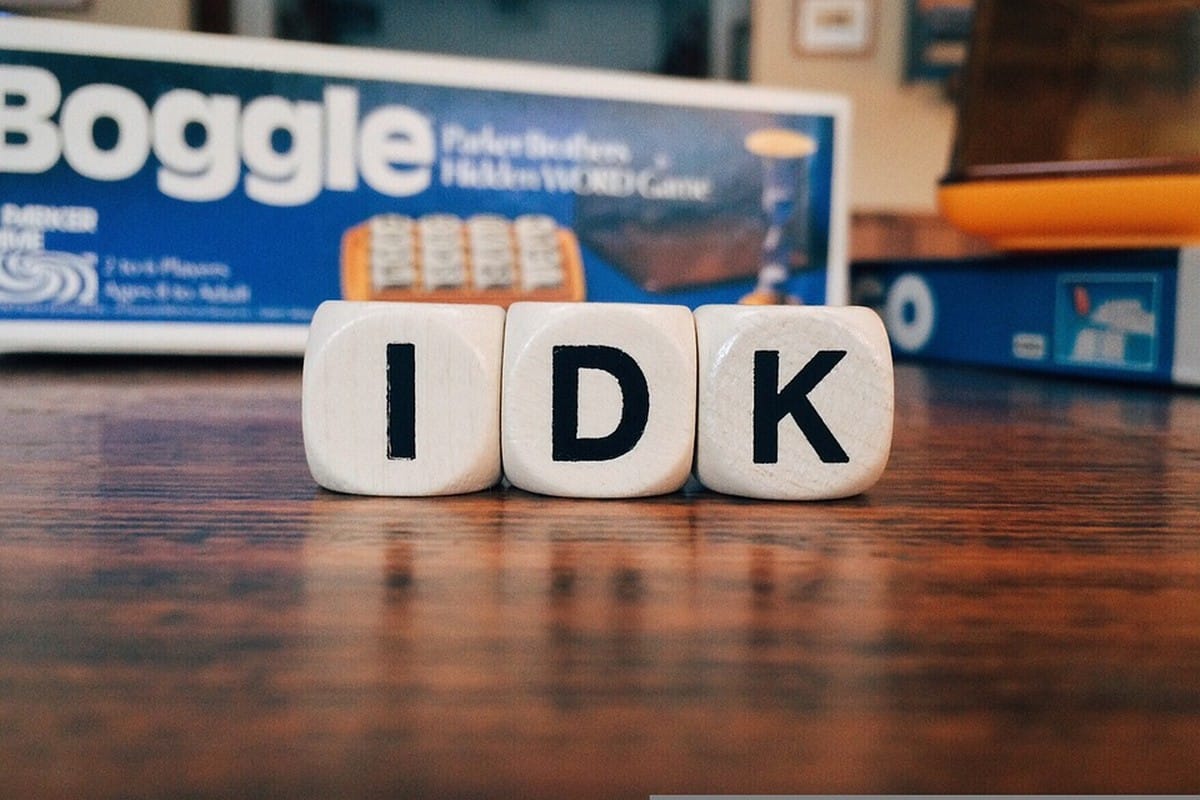
IDK means “I don’t know“, an English abbreviation that is ubiquitous in SMS and on social media.
It's a quick response when you don't know something. Here's where it comes from, its exact meaning, and some concrete examples to help you use it effectively.

Where does the word "IDK" come from?
L'abbreviation IDK comes from the English spoken in UNITED STATES. It simply replaces the sentence “I don’t know“ and first became widespread in writing as a way to respond more quickly.
the acronym makes its debut in the’Urban Dictionary in 2003, defined as the abbreviated form of “I don’t know“. From that point on, the expression spread widely, far beyond the United States.
Today, IDK is used in French-speaking communities just as it is everywhere else in the world. With the rise of social media, it has become the obvious choice for saving time in any conversation.
What does this commonly used abbreviation mean?
To understand what means IDK : it's simply “I don’t know”. It's been a staple of text messaging for years. When someone doesn't have an answer, they just say IDK rather than typing the entire sentence, for an answer fast.
The spelling isn't fixed, but the meaning stays the same regardless of case. You can mix “IDK“, “idk“, “Idk“ or even “IDk“, none of these variations is a problem. The expression is also used in spoken English, not just in writing.
Here are a few examples of sentences with IDK :
- “Where is she?” → “IDK, ”Sorry."
- “Are you coming tomorrow?” → “idk, ”, "I'll tell you about that later."
- “Who’s that guy?” → “IDK, ”, I just saw him walk by."
- “Where should we eat?” → “idk, you choose. I’ll let you know.”
How do you use “IDK” in conversation?
It's easy to use: whenever you don't know the answer to a question, just write IDK instead of typing out “I don’t know” in full. You’ll see it everywhere: in a private message, as a comment on social media, or in a group chat.
It's a informal expression, so save it for your everyday conversations. In a professional setting, whether you're young or adult, such as a job interview, a meeting, or a work email, prefers a complete and polite phrasing. In spoken language as well, IDK is still too informal for a formal setting.
Other abbreviations to know in 2026
IDK This isn't the only abbreviation you need to know. Here are the most common ones used on social media and in messages; some are also used to code conversations to keep them out of parents' reach:
- LOL (Laughing Out Loud) : the equivalent of laughing my head off, or MDR in French.
- ASAP (As Soon As Possible) : as soon as possible.
- FYI (For Your Information) : Just so you know.
- G2G (Got To Go) : I have to go.
- TTYL (Talk To You Later) : I'll talk to you later.
- IMO (In My Opinion) : In my opinion.
- TBH (To Be Honest) : To be honest.
- BRB (Be Right Back) : I'll be right back.
- OMG (Oh My God) : Oh my God.
- MP : Private Message, the French equivalent of a DM.
If you think your kids are using these kinds of codes to hide dangerous conversations, find out how to monitor your child's phone to protect it better.







 English