A USB port that is no longer responding On Windows, it's often a driver issue or of power management, not necessarily a dead port. Two simple steps usually fix the problem.
This video shows you the steps to fix a USB port that isn't working on Windows :
Explanatory video in French by Alucare, ideal complement to the page. View video (you can use YouTube's automatic translation)

Common Causes of a USB Port That Has Stopped Working
Before solving the problem, it’s helpful to identify its source. The most common causes are:
- Corrupt or outdated driver : The USB bus controller driver is faulty; Windows no longer recognizes the connected USB device.
- Selective suspension enabled : Windows cuts off power to the USB port to save energy, which causes the connected device to stop working.
- Port disabled in the BIOS : Some USB ports may be disabled in the BIOS, particularly after a BIOS update or reset.
- Hardware Problem : The USB port is physically damaged (bent pin, loose connector).
- Defective USB cable or device : The port is working properly, but the problem lies with the cable or the connected device.
Steps to Check Before Changing the Settings
Take 2 minutes to check these basic points. This prevents you from changing settings unnecessarily.
- Try another USB port on the same PC: If the device works elsewhere, the problem lies with the original port.
- Test the same device on another computer : If it doesn't respond at all, the problem is with the device or the cable, not your ports.
- Try a different USB cable : A faulty cable can cause a port to appear to be dead.
- Plug in a mouse or an external hard drive on the relevant port: This allows you to check whether Windows detects the USB device in Device Manager.
- Restart the computer : Sometimes, simply restarting the computer is enough to reset a frozen USB controller.
Also check the physical condition of the port. Dust or a twisted pin can prevent a good connection. A quick blast with an air duster often solves the problem without any software adjustments.
If none of these steps have resolved the issues, try the methods below to properly repair a USB port.
How can I fix problems with a USB port that isn't working?
Check the BIOS
If no USB port responds at startup, check to make sure the USB ports are enabled in the BIOS on your computer. To access it, restart the PC and press the key shown on the screen (often Delete, F2 Where F10 (according to the manufacturer).
In the BIOS, look for an option «USB Configuration» Where «USB Controller» and make sure it's enabled. Save and restart. This step is particularly useful If the USB ports have stopped working after a BIOS update.
Reinstall the USB bus controllers in Device Manager
This manipulation solves problems where a The driver is corrupted or frozen. Open the device manager from the Windows search bar, then follow these steps:
- In the window, scroll down to the section USB Bus Controllers.
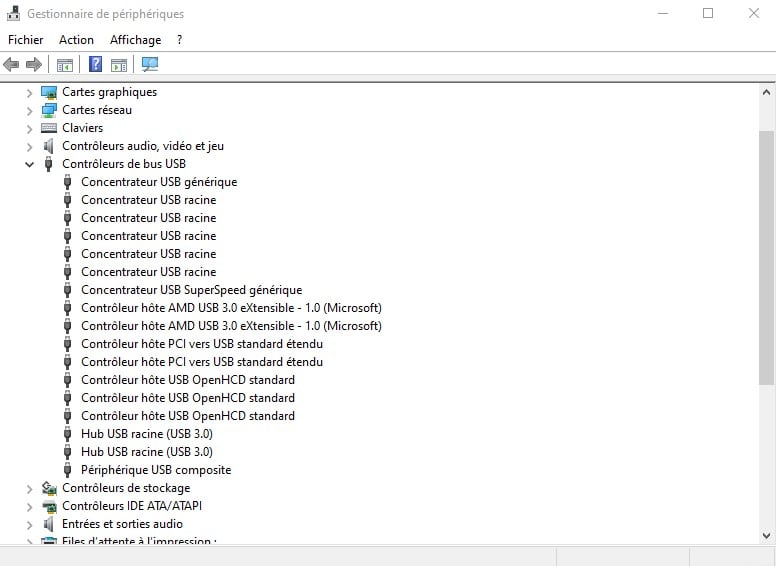
- Check if a yellow triangle appears on a controller: this indicates a driver error detected by Windows.
- Make a right click on a USB controller, then select Uninstall the device.
- Repeat this process for all USB controllers in the list. Note: If your keyboard and mouse are USB-connected, they may stop responding during this process. If this happens, restart the computer using the power button.
- Restart your computer : Windows automatically reinstalls the USB drivers at startup.
You can also select "Update Driver" by right-clicking: Windows will then search for a more suitable driver already on your computer.
To download a more recent version online, go to Settings > Windows Update > Advanced options > Uploads up-to-date optional.
After restarting, plug in a USB device to verify that the USB ports are working properly. If the Device Manager no longer shows an error (no more yellow triangle), the USB bus controllers have been successfully reinstalled.
Update USB drivers manually
If the automatic reinstallation doesn't resolve the issues, update the drivers manually. Here are the steps to follow:
- Open the device manager and scroll USB Bus Controllers.
- Make a right click on each USB controller and select Update Driver.
- Select « Automatically search for drivers » : Windows will search for a better driver among those already on your computer. If it doesn't find one, check for optional updates in Windows Update.
- Otherwise, go to the website of your PC or motherboard manufacturer (ASUS, MSI, Dell, HP, etc.) and download chipset drivers and Corresponding USB depending on your operating system (Windows 10 or Windows 11).
Updating your drivers often fixes connection errors that reinstalling alone won't resolve. Be sure to update Windows as well: a system update sometimes fixes driver issues automatically.
Disable USB Selective Suspend (Power Management)
Windows may cut off the’port power supply to save energy. This prevents the connected device from responding properly. To disable this option, search for Change the power management mode in the Windows search bar and click on it.
In the power settings, click Change Advanced Power Settings.
- In the window, scroll down USB Settings, then USB Selective Suspension Setting.
- Select Disabled on all the options that appear, then click on OK.
After completing these steps, plug in your USB devices to make sure everything is working properly.
Check the power management settings in the USB hub's properties
Each USB hub has its own power settings in Device Manager. This configuration is often the cause of problems where a USB device stops working after the computer goes into sleep mode.
Here's how to check and correct this setting:
- Open the device manager.
- Unroll USB Bus Controllers and make a right click on a generic USB hub.
- Select Properties, then the tab Feed management.
- Uncheck the option «Allow the computer to turn off this device to save energy».
- Repeat this process for all the USB hubs on the list, then restart the computer.
This setting is different from selective suspend: it affects each USB hub individually. Both should be disabled to resolve power-saving issues related to USB ports.
Check via the command prompt
If the troubleshooting steps didn't resolve the issues, you can check the system files using the’order form. Corrupted system files can prevent USB ports from working.
- Research cmd in the Windows search bar, then open the Command Prompt as an administrator.
- Type the command
sfc /scannowand press Entrance. - Windows automatically scans system files and repairs any errors it finds.
- After the scan, restart the computer and check to see if the USB ports are working properly.
This command is useful when multiple USB devices stop working at the same time, which may indicate corruption in the operating system.
Case of a defective external USB hub
If you're using a USB hub (USB hub), test it directly without the hub. A faulty or underpowered hub can cause all USB devices connected to it to stop working, even if your computer's ports are functioning properly.
Unplug the hub, connect a USB device directly to a port on the computer, and check to see if the problem persists. If the USB ports work properly without the hub, replace the hub or use a hub with an external power supply.
If the USB port still isn't working: hardware repair
Has no software solution resolved the issues? If so, the port is likely experiencing a hardware problem and physically damaged. A technician can diagnose the problem and replace the defective port.
As a general guide, at an independent repair shop, expect to pay approximately:
- Desktop PC: 30 à 60 €.
- Laptop: 50 to 180 €, because the port is often soldered directly to the motherboard.
- If the motherboard needs to be replaced, the invoice may exceed €400.
Before sending your computer in for repair, check to see if it's still under warranty. If so, the manufacturer's support team may cover the repair at no cost. For a laptop, cContact the manufacturer's support team is often the quickest solution.








 FR
FR  RU
RU  EN
EN  ES
ES  IT
IT  DE
DE  ZH
ZH  PT
PT  ID
ID  JA
JA  DA
DA