the type Normal has only one weakness: the type Combat, which deals double damage to him (×2). On the other hand, it is completely immune to the Spectrum type : No Spectre-type attacks can hit it.
Easy to remember, and crucial in every game, from Pokémon Scarlet and Violet at Pokemon Go (where immunity becomes strong resistance). Also check out a complete picture Weaknesses by type for further exploration.
How do you beat a Normal-type Pokémon?
To beat a Pokémon type Normal, the strategy is straightforward. You have to send him a Fighting-type attack : This is the only move that’s truly effective against him. The damage is doubled, which is usually enough to turn the battle around.
Focus on Fighting-type attacks
Here are three Pokémon battle type reliable ways to exploit this weakness:
- Mackogneur : one of the most accessible models from the very first generation. Its attack Dynamopoing, which is sure to move people thanks to his talent Cancel Shift, deals massive damage to any Normal.
- Lucario : Very versatile, it packs a punch in both physical and special attacks. Its Mega-Evolution, available since Pokémon X et Y, makes it even more effective.
- Terrakium : double type Rock/Fight, he can take a punch and hits hard. In Écarlate et Violet, it can be accessed via the DLC 2: «The Indigo Disc».
In practice, any powerful Combat attack will do against a Ronflex or one Regigigas. The key is to withstand their Normal-type attacks, which are often very powerful.

Normal-type offensive effectiveness
On offense, the Normal-type attacks are neither resistant to nor particularly effective against most types. They deal normal damage to virtually all types in the game.
Two important exceptions:
- Normal attacks are completely ineffective against the Spectre type : They have no effect—zero damage.
- Types rock and Steel Resistant to Normal-type attacks: Damage is halved.
Except in these cases, a Normal-type attack hits with standard effectiveness. It is a neutral offensive type, with no particular strengths or weaknesses against other types.
The Abilities of a Normal-type Pokémon
The Normal type has the most moves in the game: there are more than 200. Many of these attacks can change their type thanks to certain talents.
Among the most powerful attacks:
- Giga Impact : The go-to physical attack. Very powerful, but it forces you to recover on the next turn.
- Explosion : massive damage, at the cost of knocking out the caster. The base power is 250.
- Guillotine and Empal’Korne : Attacks that knock out the opponent with a single hit if they land, regardless of the opponent's HP.
- Charge : the basic attack, available starting with the first generation, which has limited impact but is learned by a vast majority of Pokémon.
These attacks deal decent damage to most opponents, but they are completely ineffective against the Spectre type.
Normal-type Pokémon resistances
Defensively, the type Normal is not resistant to no type. It does not benefit from any specific damage reduction, which remains its main limitation when facing specialized opponents.
On the other hand, it has a unique immunity to the Spectre type. Spectre attacks simply can't hurt him.
This immunity is reciprocal: a Pokémon Specter also ignores the Normal Attacks.
So there's no point in sending out a Normal-type Pokémon against a Ghost-type: neither can deal damage to the other with its base type.
Everything You Need to Know About the Normal Type in Pokémon Games
the type Normal is the most basic of the 18 types in the game. It's also one of the most common types in the Pokédex, right behind the type Water.
In business since first generation, it remains a must-see until Pokémon Scarlet and Violet. Each new generation brings its own set of new Pokémon of this type.
In the trading card game, this type corresponds to the colorless type. This is an important distinction: a Normal-type Pokémon in the video games does not necessarily correspond to a colorless Pokémon in the card game.
The Most Common Types of Doubles
Many Normal-type Pokémon have a double type. The most common combination is Normal/Vol. It involves Pokémon such as Roucool, Hoothoot, Doduo, Dodrio or Étouraptor (4th generation).
A dual-type Pokémon Normal/Vol gains additional weaknesses. It becomes vulnerable to the following types Roche, Électrik and Ice cream. Its weakness against the Fighting type disappears, because the "Vol" type makes up for it.
The jumpsuit Normal/Floor remains very rare throughout the entire series. The Normal/Fairy is also underrepresented, but it adds an immunity of the type Dragon and resistors of the following types Darkness and Bug, while retaining the Specter ability.
Weaknesses of dual-type Pokémon that include Normal
| Double type | Weaknesses | Immunities | Resistors |
|---|---|---|---|
| Normal/Vol | Rock ×2, Electric ×2, Ice ×2 | Spectrum, Sol | Insect, Plant |
| Normal/Fairy | Poison ×2, Steel ×2 | Spectre, Dragon | Insect, Darkness |
| Normal/Psychology | Insect ×2, Darkness ×2 | Spectrum | Psych |
| Normal/Fire | Fighting ×2, Water ×2, Rock ×2, Ground ×2 | Spectrum | Fire, Plant, Ice, Insect, Steel, Fairy |
Iconic Normal-type Pokémon
A few species stand out in combat:
- Ronflex : a formidable defensive wall, with some of the highest HP in the game.
- Regigigas : a legendary Pokémon with enormous offensive potential, held back by its ability A Quiet Start at the start of the battle.
- Leuphorie : prized for its massive HP, Special Defense, and support abilities.
- Porygon-Z : Excellent at special attacks; often used in competitive play.
- Métamorph : prized as a counterattacker thanks to his ability to mimic his opponent and change his form.
- Méloetta : Introduced in the fifth generation, it can change its form and secondary type during battle, switching from Normal/Psychic to Normal/Fighting.
- Évoli : known for its eight possible developmentss, which cover eight different types.
- Arceus : Listed as Normal by default in the Pokédex, its type can change depending on the Plate it’s wearing. It’s one of only two Normal-type Pokémon, with Silvallié, capable of becoming any other type.
- Terapagos : Introduced in the "Indigo Disk" DLC for Scarlet and Violet, it is a Legendary Normal-type Pokémon whose Terastal type is fixed as Stellar.
- Silvallié : works like Arceus on a smaller scale. Its type changes depending on the Memory it carries, but it remains Normal when it has no item.
History of the Normal type by generation
Each generation has introduced new iconic Normal-type Pokémon:
- Generation 1 : Rattata, Ronflex, Kangourex, Porygon, Métamorph, Évoli.
- Generation 2 : Leveinard evolves into Leuphorie. Arrival of Hoothoot and Girafarig.
- Generation 3 : Skitty, Delcatty, Kecleon, Spinda, Vigoroth. Porygon2 evolves into Porygon-Z as early as the next generation.
- Generation 4 : Regigigas makes its appearance. Porygon-Z is introduced.
- Generation 5 : Méloetta comes in two forms, alongside Ponchiot, Chinchidou, Ratentif, Frison and Nanméouïe.
- Generation 9 (Scarlet and Violet) : Terapagos, Gourmelet, Compagnol and Deusolourdo are added to the list.
Special Features in Pokémon Go
In Pokémon Go, the type system works similarly to the main series games. The Normal type retains its sole weakness against the Fighting type.
On the other hand, the There are no immunities in Pokémon Go : Spectre attacks still deal ×0.39 damage to a Normal-type Pokémon.
Here are some important details about arena battles and raids:
- The damage modifiers are slightly different: ×1.6 for effective attacks (instead of ×2 in the main games), and ×0.625 for less effective attacks.
- Ronflex It remains one of the best Normal-type defenders in the arena, thanks to its exceptional HP.
- Regigigas is available in Legendary Raids and retains its status as a top Normal-type Pokémon.
- The attacks Giga Impact and Charge are present in the game and play a role in offensive strategies.
List of Normal-type Pokémon

Here is a selection of Pokémon that are of the Normal type, listed in alphabetical order:
- Arceus
- Argouste
- Azurill
- Brouhabam
- Capidextre
- Capumain
- Cerfrousse
- Chaffreux
- Chaglam
- Chinchidou
- Chuchmur
- Compagnol
- Couafarel
- Coudlangue
- Delcatty
- Deusolourdo
- Dodoala
- Dodrio
- Doduo
- Écrémeuh
- Étouraptor
- Évoli
- Excelangue
- Famignol
- Fouinar
- Fouinette
- Fragroin
- Frison
- Girafarig
- Goinfrex
- Gourmelet
- Hoothoot
- Insolourdo
- Kangourex
- Kecleon
- Keunotor
- Laporeille
- Leuphorie
- Leveinard
- Linéon
- Lockpin
- Manglouton
- Mangriff
- Mastouffe
- Méga-Kangourex
- Méloetta
- Métamorph
- Miaouss
- Miradar
- Monaflèmit
- Morphéo
- Moumouflon
- Moumouton
- Nanméouïe
- Parecool
- Pashmilla
- Persian
- Ponchien
- Ponchiot
- Porygon
- Porygon2
- Porygon-Z
- Ptiravi
- Queulorior
- Ramboum
- Ratentif
- Rattata
- Rattatac
- Regigigas
- Ronflex
- Rongourmand
- Rongrigou
- Sapereau
- Silvallié
- Skitty
- Spinda
- Tauros
- Teddiursa
- Terapagos
- Ursaring
- Vigoroth
- Zigzaton
Summary Table of the Strengths and Weaknesses of the Normal Type
Here is a table summarizing the strengths and weaknesses of the type Normal, as well as the effectiveness of its attacks against other types:
| Situation | Type in question | Effect |
|---|---|---|
| Defensive weakness | fight | Damage taken ×2 |
| Defensive Immunity | Spectrum | No possible impact |
| Defensive Resistance | None | No damage reduction |
| Ineffective Offensive Attacks | Spectrum | No damage dealt |
| Offensive attacks with limited effectiveness | Rock, Steel | Damage reduced by half |
| Neutral Offensive Attacks | All other types | Normal damage |
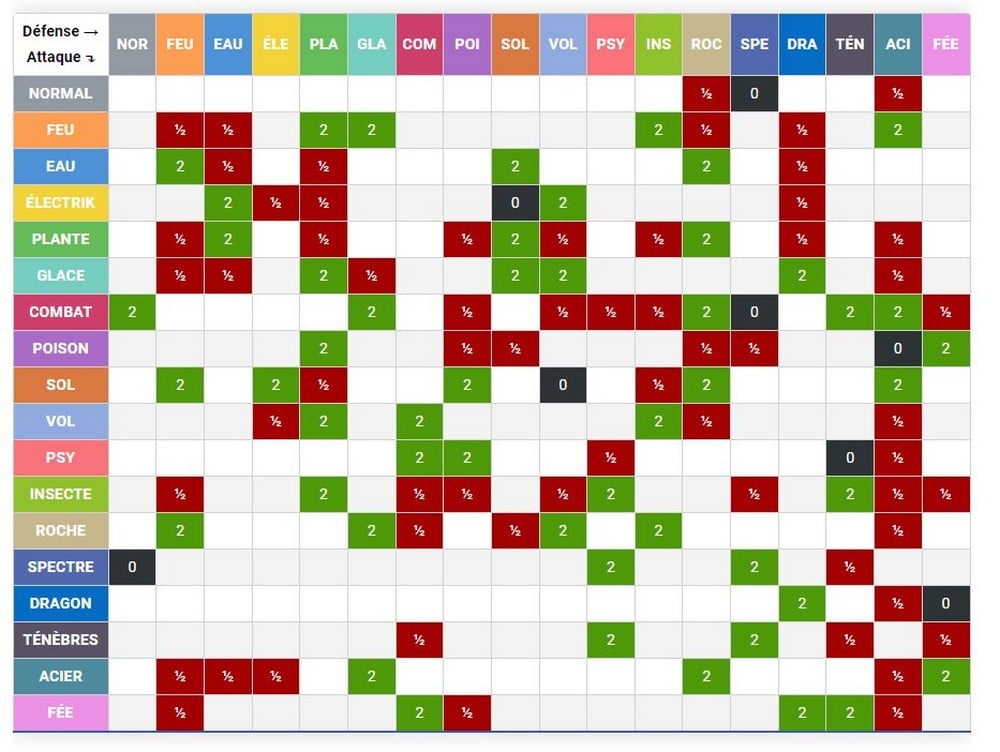
Here's how to read the general table of types:
- the 2 green : Effective attacks, double damage.
- the 1/2 red : Attacks are not very effective; damage is reduced.
- the 0 black : completely ineffective attacks, with no impact whatsoever.
You can also find all our other fact sheets on weaknesses by type:
- Fire-type Pokémon weaknesses
- Weaknesses of Electrik-type Pokémon
- Plant-type Pokémon weaknesses
- Poison-type Pokémon weaknesses
- Vol-type Pokémon weaknesses
- Psy-type Pokémon weaknesses
- Insect-type Pokémon weaknesses
- Dragon-type Pokémon weaknesses
- Weaknesses of Darkness-type Pokémon
- Weaknesses of Fairy-type Pokémon
- Ice-type Pokémon weaknesses
- Rock-type Pokémon weaknesses
- Steel-type Pokémon weaknesses
Now you know the Weaknesses and Resistances of the Normal Type. This will help you refine your strategy the next time you encounter one of these Pokémon in battle.









 FR
FR  RU
RU  EN
EN  ES
ES  IT
IT  DE
DE  ZH
ZH  PT
PT  ID
ID  JA
JA  DA
DA